Wednesday, 2 March 2011

a field student of Be u lah Pa th

Beulah Path 27/02/11 Addison Road to Maynard Road

Traumatised by the vision of post-coital remains on Folly Lane (the concrete penetrations of psycho sexual van men tippers and marauders), I needed the refuge of a safer dream space - one which would not accommodate such phallic girths. I decided to disguise myself as an invisible cloven hoofed beast and trot the confines of Walthamstow's nocturnal labyrinth, in search of flora and their delicate scent to sooth my troubled soul.

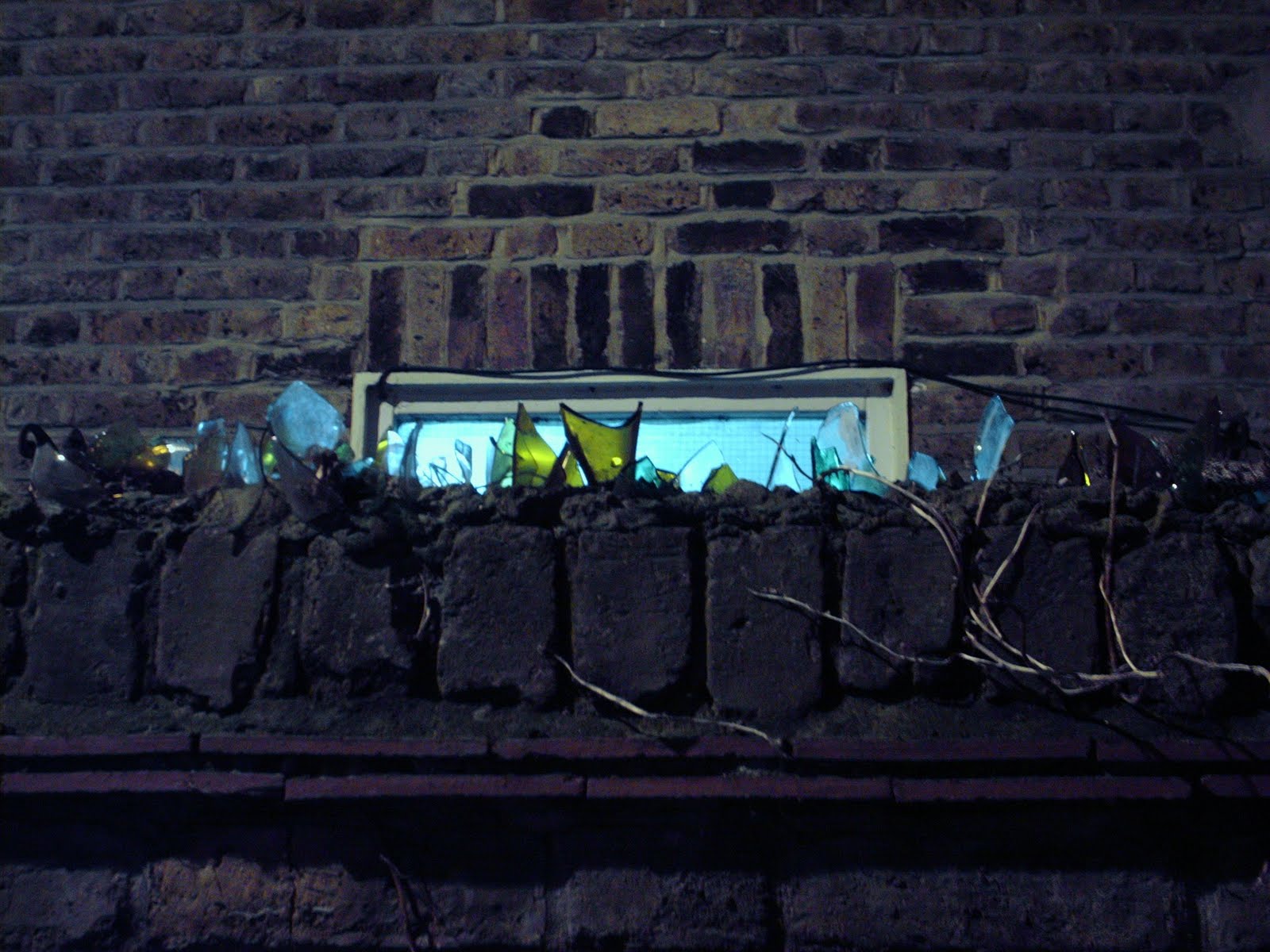
Out of the darkness came this pyrotechnical flash of Forsythia, harbinger of Spring.


Keen to maintain at least the semblance of social utility, a counter to the occasional fatuousness of Lost and Found in E17, the field student of E17 has sought out lists of plants which provide pollen and nectar for bees and alas it seems Forsythia is not among those which will satiate, if that is ever possible, their primal desires.

This list comes from The National Bee Unit

The following flower species are inviting to bees. There are many more:


Comfrey Symphytum spp.
Yellow archangel Galeobdolon luteum
White deadnettle Lamium album
Red deadnettle Lamium purpureum
Sages Salvia spp.
Thymes Thymus spp.
Marjoram Origanum vulgare
Rosemary Rosmarinum officinale
Lavenders Lavendula spp.
Lambs Ears Stachys lanata
Skull Caps Scutellaria spp.
Bugles Ajuga spp.
Geraniums Geranium spp.
Snapdragons Anthirrinum spp.
Toad Flaxes Linum spp.
Sweet Peas Lathyrus spp.
Buddleia Buddleja davidii
Foxglove Digitalis purpurea.


Fruit and vegetable plants which are inviting include:
Blackberry
Red currants
Black currants
Raspberries
Strawberries
Apples
Pears
Broad beans
Runner beans
Peas

The importance of trees as a food source cannot be over emphasized. Willows in particular represent a good source of pollen early in the spring.

The British Beekeepers Association has produced a leaflet specifically about trees for bees, from which I will report at a later date.

In, Bees and Honey (George A. Carter, B.Sc., A.R.I.C.) A guide to the better understanding of bees, their diseases, and the Chemistry of Bee-keeping, pub' 1945 - some of the complexities of what makes a plant a good source of pollen/nectar, are described; for instance, the composition of the soil and sub-soil.

Sunday, 27 February 2011

a field student recognizes the folly of his ways

Folly Lane 27/02/11.


"What you doing you f****** p****? (?!) Don't walk in front of me, you f****** c***"


.

(was it a question?)


I'm unsure what I found more offensive; what the van driver said or the singular lack of imagination in the (attempts at) insults he bellowed at me. I think I deserved better insults than that. Come on man, you can do better than that. What had I done to warrant this tirade from the driver on Hall Lane close to where it joins the A406?


I had stepped onto and begun a walk across a zebra crossing in broad daylight. The driver had taken umbridge at having to stop - stopping with his front wheels well onto the markings while I was half way across. I had all ready allowed one car to pass while standing at the kerbside, so as I understand the highway code, I had right of way and the van driver, who had started to accelerate towards the crossing, was contravening the highway code. I was wearing a high visibility top and walking (with) my bicycle across the crossing.

.


This typically contradictory advice comes from Devon County Council:
.


ZEBRA crossings are marked by black and white painted strips across the road and flashing amber beacons. The Highway Code says that motorists 'MUST give way when someone has moved onto a crossing'. However, pedestrians should remain on the kerbside for safety's sake until approaching vehicles have stopped. Zebra crossings are cheaper to build than traffic signal crossings although their use on roads where traffic speeds are higher than 35mph is not recommended.


Rule 19 for pedestrians, in The Highway Code:

19
Zebra crossings. Give traffic plenty of time to see you and to stop before you start to cross. Vehicles will need more time when the road is slippery. Wait until traffic has stopped from both directions or the road is clear before crossing. Remember that traffic does not have to stop until someone has moved onto the crossing. Keep looking both ways, and listening, in case a driver or rider has not seen you and attempts to overtake a vehicle that has stopped.


Rule 195 for motorists, in The Highway Code


195
Zebra crossings. As you approach a zebra crossing

•look out for pedestrians waiting to cross and be ready to slow down or stop to let them cross
•you MUST give way when a pedestrian has moved onto a crossing
•allow more time for stopping on wet or icy roads
•do not wave or use your horn to invite pedestrians across; this could be dangerous if another vehicle is approaching
•be aware of pedestrians approaching from the side of the crossing

A zebra crossing with a central island is two separate crossings (see Rule 20).

[Law ZPPPCRGD reg 25]


Motorists are obliged to slow down when approaching pedestrian crossings, and more so if there are pedestrians in close proximity to the crossings. This is safe, lawful and considerate driving. Unfortunately it seems motorists are increasingly not respecting this pedestrian right of way. If it is so that a motorist can have right of way if he/she/it is able to cover the distance between their vehicle and the crossing while keeping within the speed limit - even if there is a waiting pedestrian or one making the first step across - why have zebra crossings at all? Do away with these death traps and create pedestrian no go zones. To know, as a pedestrian, you have a right of way across a busy road is reassuring and enabling if not empowering.


More and more, I have seen pedestrians thanking motorists for stopping at zebra crossings. For heaven's sake don't. To thank a driver for stopping only adds to the autocultural abuse of the pedestrian and is contributing to an unjust sense of entitlement on the part of the motorist.


Why has the London Borough of Waltham Forest put a zebra crossing so close to the junction of Hall Lane and the North Circular/A406 - a location where motoring is likely to be more belligerent? Would it not be better to have a Pelican or Toucan crossing here?


An answer to this question might come in the form of an image of the muddied pedestrian ways of the council when providing for those in the community who chose not to drive


I think it would be fair to say this path is excremental.

Over in Found Objects there is a hauntological blogger posting images of ghost signs - here is Lost and Found in E17's contribution to this ghostly and, in some places, ghastly dialectic.

.


What did I say, in reply to the van driver? "Get a move on you idiot, you're holding up the traffic."


I do have some sympathy for the brothers and sisters in the beleaguered offices of the LBWF. There are rumours circulating in the mind of this blogger that an extreme sect of auto eroticist van men ('hot' off the lanes of Southend Road) are mounting a campaign of insurgence aimed at vanquishing any respect whatsoever for the cyclist and pedestrian. In a sort of (J G) Ballardian inspired vision I shuddered at the thought of the 'relationship' between the driver and gear stick as he/she/it plunged into the council's defences.

a field student of free love and reproduction

Lost and Found in E17 has of late become a site of increasingly morbid musings while attempting to commune with the spirit(s) of erstwhile psychogeographers. Indeed, swine flu, cholera, bubonic plague have all featured prominently in this consumptive process and so, in the manner of Daniel Defoe’s fellow fear stricken denizens, I made for the hills this morning, to commune with nature and free myself of the vice and miasma of the Big Smoke. Not for me then, the likes of the littered streets of Soho or the Machiavellian hive of E17 et al. No, the northern fringes and allotments of E4 verging on Epping Forest were to be my temporary sanctuary today.

On a belly full of coffee, toast and honey I decided to retrace the gallops of Dick Turpin up into ‘the Chingfords’, mentally and physically pedalling this picaresque allusion along the way. Little hope then that I would actually free my mind of the mores of more inner London.

In the forest garden sanctum it was not long before the sexual proclivities of Mother Nature were all around me in startlingly vivid analogue. A particularly fine specimen of a corkscrew hazel (Corylus avellana, 'Contorta') displayed its sexual prowess with pendulous vegetable grace. In a moment of strange temporality I was immersed in the erotica of this field somewhere between this

http://www.arkive.org/hazel/corylus-avellana/video-09.html

and these

.

.

And now, nowhere near where I was, I will make excuses for my relapse by claiming this field student of E17 was earnestly studying the cycles of reproduction which provide Walthamstow and surrounds with ultra local ambrosial delights. Near to this site of free love, apian gatherings were in evidence.

Thursday, 24 February 2011

a field student pays homage

I went home that evening greatly oppressed in my mind, irresolute, and not knowing what to do. I had set the evening wholly apart to consider seriously about it, and was all alone; for already people had, as it were by a general consent, taken up the custom of not going out of doors after sunset; the reasons I shall have occasion to say more of by-and-by.
Daniel Defoe, A Visitation Of The Plague


Lost and Found poster, Soho, London. Feb' 2011 (photo: Julian Beere)


I have been trying to find the flyer, invite or advert’ David Dellafiora disseminated for ‘From Castaway to Plague Years - Mail Art Homage to the Life and Works of Daniel Defoe’. They or it would complement the following images/scans of the documentation I received having contributed to that show. Invitations or calls for submissions go some way towards explaining some of what a mail art show is, was and could be.


Exhibition Documentation - A6 stapled booklet, 20 pages, photocopies + photograph + rubber stamp prints + Daniel Defoe net note. Designed and produced by David Dellafiora. Reproduced by permission.


photo: David Dellafiora


Losing and Finding Memories

The interior of Lost and Found in E17 is a condensed and compressed terrain - a deep topography of modest furnishings, domestic accoutrements and personal affects packed in boxes within boxes stowed away in the nether and over reaches of what is the field student’s bedsitting room. Whereas the more accomplished of you might have separate rooms for the pursuit of your pleasures, this cloistered personage retreats to the confines of corners to indulge in his ‘pleasurely’ pursuits. To retrieve a memory such as a mail art exhibition flyer involves embarking on a perilous archival expedition. Avalanches from atop cupboards and cave-ins beneath beds have cramped the determination and enthusiasms of the field student as intrepid explorer on many an occasion. I must draw some maps of this room.

A field student seeks context and precedent

Less accomplished - a psycho persona manqué? No! The field student of E17 can qualify his status quo by resorting to the lives of others, identifying with such bedroom luminaries as Xavier de Maistre, brought to him by the erudition of Merlin Coverley’s, Psychogeography. Lost and Found in E17 (Me, Myself and I) can stake claims to the flaneury of, A Journey Around My Room, and, A Nocturnal Investigation Around My Room - the whole time residing in a childish and/or adult psyche. In the manner of psychogeographer, de Maistre, do I actually have to read those tomes; shall I imagine I have read them and give an account of that literary journey? What sort of pretentiousness would this be? I do all I can to avoid the hormonal quagmire and student japery of adolescent situationalism and God damn, one refuses be drawn in that guise.

Mr Beere, what has this got to do with, From Castaway to Plague Years?

The castaway, Robinson Crusoe, is cited as a pre-eminent and influential figure in psychogeography, an archetype all most. Crusoe was isolated and marooned - cut off from the known world by a vast, cruel and unforgiving ocean.

Defoe, the merchant, in ‘A Journal of the Plague Year’ was also isolated, surrounded by (a sea of?) pestilence and those who quacked in it, as well as the official restrictions to control the spread of the disease.

Each had recourse to his imagination and the wandering mind.

An ethos of mail art was to counter some isolation by artistic communication through the post - and to foster the artistic activities born of isolation, separation, exile, embargo and loneliness. Mail Art could be a culture of connection and exchange via the posted gift. Could it be all those names and addresses in the documentation are ‘Robinsons’ - ‘Robinsonnaires’ who posted calls for recognition and reassurance if not rescue from across the fluxus flows - each item of mail a site of real and imaginary meetings?

Each of us might tell of...

The Life and Strange Surprizing Adventures of ............................., of ................................, Mariner: Who lived Seven and Ten Years, all alone in an un-inhabited Island on the ....................., near the Mouth of the Great River of ...........................; Having been cast on Shore by Shipwreck, wherein all ................... perished but ........self. With An Account how ......... was at last as strangely deliver’d by Pyrates

In my post to the show I cast a clear plastic pop bottle into the mail art ocean. The unwrapped bottle contained a collection of partially rusted nails salvaged from the wreckage of a shed recently destroyed in a storm - homage to Daniel Defoe.


A field student considers a deep sea expedition in search of a crew lost to the depths of the V&A.

Julian Beere said...

Hi David, a big hat tip to the dedication of Field Studies' emanators and manifestators for this fluxus insurgence of the corridors of arts and crafts power - fluxus is life!

'Back in 1993 the Theatre of Names and Addresses studied the field of the V&As lost property department. Field students J.Beere and K.Keller collaborated in the planting of a used William Morris willow pattern decorated address book in the said department. By some mysterious circumstance the book was nowhere to be found when we tried to reclaim it. 17 years should be long enough for them to have found it - if not, Field Studies' manifestations will certainly be more than compensation'.


Yours sincerely,

Jules Beere.

Tuesday, 22 February 2011

a field student of Walthamstows dark marshlands

Lost and Found in E17 seeks to map some of the outdoor public art in Walthamstow and the wider borough. Of particular interest to this field student of E17 (et al), is missing or lost public art.
My daily cycle commute to work usually takes in the mixed pleasures of the Lea Bridge Road and surrounds. This morning I caught sight of this sign at the junction of Lea Bridge Road, Orient Way and Argall Way.
.


Keeping in with the flow of cycle traffic, I could only manage a cursory glance to look for the sculpture - which I recalled being a light or beacon - before disappearing into the waterworks and on to Hackney Marshes. Was it still there, I asked myself? I made a mental note to look for it on the way home; a journey I knew would take place in the dark.
On return to the junction I couldn’t see the light or the sculpture. I examined the sign a little more, as well as the site immediately around it looking for other signs of the sculptures presence.
The sign reads:
.
The Bulrush
Created and designed by artist Andrew Dwyer of Free Form Arts Trust, the Bulrush Sculpture relates to the reed which grows in the nearby Walthamstow Marshes.
It was commissioned by the Lea Bridge Gateway Partnership and the London Borough of Waltham Forest to celebrate the regeneration of the local area.
.

I have travelled up and down the Lea Bridge Road many times in the 10 years I have lived in the area. I am unsure how long it was I didn’t miss ‘The Bulrush’.
I’m missing it now. I’d like to know what has happened to it. I have tried going to the LBWF website to get some information and I have not found answers there. Andrew Dwyer has a website (http://www.andrew-dwyer.co.uk/index.htm) on which there are some images of the sculpture. I have also emailed him asking if he knows anything about the fate of ‘The Bulrush’. There doesn’t seem to be an entry for ‘The Bulrush’ on the Public Monuments and Sculpture Association website although there is some information about a sculpture (River God) in the grounds of the waterworks at Coppermill Lane - a sculpture which is normally out of view to the public.
.
Here are some links to the sculpture, ‘River God’ which has some connections to 'The Bulrush'.
.
Perhaps ‘The Bulrush’ was intended as a temporary installation, one that fulfilled its purpose and so was removed accordingly. It might be the cost of maintaining it as a working light was too high and that a ‘dead’ light was too incongruous a presence for something supposed to be symbolising ‘regeneration’.
I’m unsure what sorts of bulrush grow on Walthamstow Marshes.
Connecting with a recent thread, the subject of polluted water, ‘The Bulrush’ may have had a fitting presence as symbolising something which can purify water - a form of regeneration essential to all.

Monday, 21 February 2011

a field student of Beulah Path

Beulah Path 20/02/11

Walking from Grove Road towards Barclay Road


and nowhere near Beulah Path

.

.
.
.


Sunday, 20 February 2011

a field student of monstrous soups


Liz Ellis of 'Rivers under the pavement' facilitated an event at The Big Table, Coppermill Fields, today. The event was held in part to mark World Social Justice Day.
The event was a meeting of hearts and minds with a picnic and talks/activities for everyone to take part in.
As a 'Lost and Found in E17' segue to yesterdays post showing the Anti Cuts march up Hoe Street, artist Fran Wilde gave a talk about Ekta Parishad, a movement and organisation which campaigns for Land Rights and Social Justice for people in rural India. One of the ways the campaigns happen is via mass participatory walks or marches over hundreds of miles involving thousands of people. If I heard correctly, some walks have seen up to 30,000 people walking together over many miles and nights and days. Over the course of a whole walk, hundreds of thousands of people will have participated. The organisation and support which enables the walks to happen is all the more remarkable given the relative material poverty and deprivation the people endure.
for more information,
.
The talk and discussion I presented, 'The Monstrous Soup of the 19th Century' began by asking what rights we have concerning water. We looked at the history of water provision in 19th century London, illustrated in part by cartoons from Punch, Fun and The Times. The history of water provision in Victorian London is one of stinks and cholera epidemics made all the worse for the institutional resistance to the development of a clean water supply. That people died in their thousands was attributed to (long discredited) miasma theories and disdain for the 'irregular' lives of the urban poor.
.
The cartoons we looked at:
Monster Soup, 1828. William Heath (Paul Pry).
Father Thames introducing his offspring to the fair city of London, 1858. John Leech. (Punch 182)
The Silent Highwayman, 1858. John Tenniel. (Punch 183)
Sanatory Measures, 1848. John Leech. (Punch 112)
Deaths Dispensary, 1866. George Pinwell. (Fun. 18/8/66)
.
One of the comments (in the big table discussion) in response to an account of the 1866 East End cholera epidemic pointed to the likelihood of racism/anti-semitism being a major factor in the pumping of dirty water into the East End.
.
If in 1866, you were able to read, or knew someone who could read, there were cholera warning posters giving the following advice:
.
If there are any dust or dirt heaps, foul drains, bad smells or other malign smells in the house or neighbourhood, make complaint without delay to the Local Authorities having legal powers to remove them, or if there be no such authorities, or if you do not know who they are, complain to the Board of Guardians.
.
While Londoners now enjoy relatively safe clean water - and by various statutes, a right to this, many around the world don't. Locally and globally, with burgeoning urban development and population growth there is an urgent issue of how every human being can get clean water and maintain a right to it.
I was surprised to read the United Nations Universal Declaration of Human Rights and not find specific mention of water in it. Article 25 could be interpretted to include clean water as a right - and I was told by one of the participants there is another bill of rights based on the UN's which does declare clean water explicitly as a right.
.
As a way of concluding on a slightly less grave note we played a game of 'exquisite corpse' assembling new monsters for the soup pot - a few of the exquisite monsters are presented for your indigestion.
.
One of my aims with 'Lost and Found in E17' is to map and record in various ways, outdoor public art in Waltham Forest. The Big Table (table on the marsh) is one of these art works. 'A field student couldn't get a table at the marsh' presents some photographs from the opening of the table in October 2010.