Saturday, 6 April 2013

Field Study's Man in E17 is lost in the plots

Plot A

Field Study's Man in E17 is still lost in the allotment. His mission is to map the terrain to express a sense of place more creative and nurturing than the lamentable, inadequate and incomplete mapping effort above does. 'Your map has reduced the place to a barren waste', the field student declared before setting off. Some of the photographs below feature areas of the allotment site which are beyond the severe boundary of that map. I hope the field student will return with a more comprehensive and searching map of 'the farm' (as some of our peasant collective are now calling the site) for I fear the photographs I took (on 30th March), as a way of documenting our progress, are still somewhat arid. The tenacity of winter is a poor excuse. 

I have two impossible explanations for the field student's absence; the first, that he did meet with the spirits of Victor Grippo, Kurt Schwitters and Robert Rauschenberg and they decided to form an artist colony beneath one of the sites' many and secluded piles of raw 'merz' material. The eminent art critic, Brian Sewell, has explored the excremental connotations of Schwitters' 'merz' in a review of Schwitters in Britain. It may be there is a 'super Wagnerian total-shit-art-work' somewhere here and I am working on improving my connoisseur-ship to be able to tell the difference.
The second explanation arises out of the curious case of my missing copy of, Home Economics (Wendell Berry). I suspect the field student took it (without asking) to use as a guide to the complexities of the interdependence of domesticity and wilderness - culture and nature, if you like. I imagine the field student has curled up with the book under a prickly pile of bramble, gooseberry and worcesterberry 'prunings'. Field Study's Man in E17 may not be aware the book is not mine; it belongs to the library and I have to return it soon.

If you spot the field student in the photos please do tell me as I will see if he is still there and so get the book back.

Saturday 30th March 2013

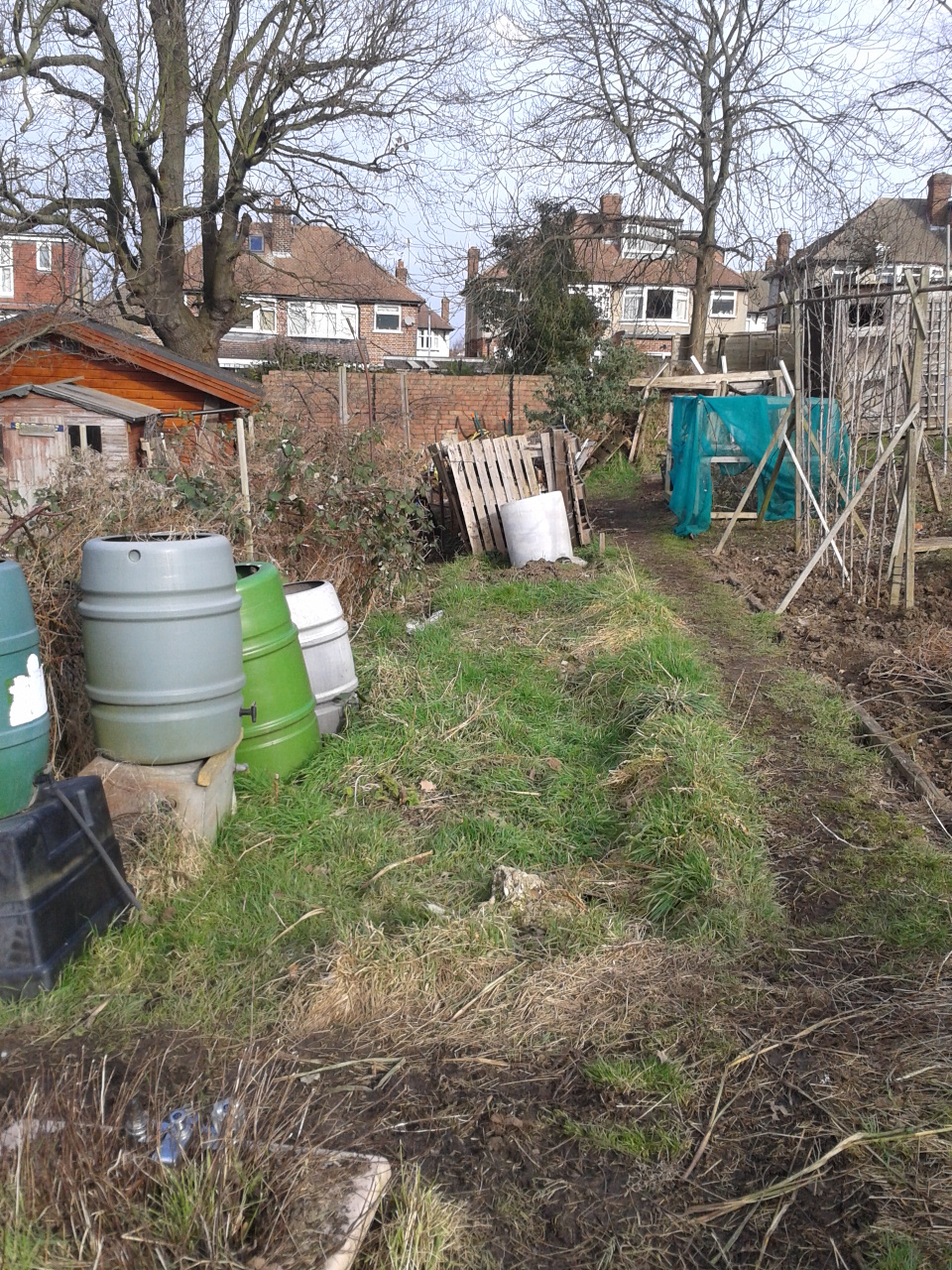
Bed 1 - liquid feed bins
The compost bays have been moved and rebuilt and the liquid feed (nettles & comfrey) bins rearranged.

Bed 1 - new raised bed/compost bays
(legumes)
Having moved the compost bays along - that section of the bed is ready for cultivation 

Bed 1a - Bramble Hedge
The blackberries have been pruned, thinned and also retrained via another tier.

Bed 1a - Bramble Hedge - picking path.
The reorganization of the liquid feed bins and the retraining of the bramble hedge has created easier access to the entire length of the hedge.

Bed 2
(brassicas)
Posts have been installed in readiness for the netting of the kale and purple sprouting broccoli. 

Bed 2 - swede/rocket
Some early sowing of swede and rocket has been tried at this end of the bed.

Bed 3 - garlic
(roots)
Garlic (saved from last year) was planted in November. Spinach was sown 3rd March at the end of the bed.

Bed 3 - parsnips
3 rows of parsnips were sown at the beginning of March

Bed 4 - perennials
e.g. wild garlic
Wild garlic, pulmonera, primroses, nettles and chives....

Bed 4 - blackcurrants

Bed 4 - rhubarb
A new bed established for rhubarb

All the beds have been treated with rock dust during winter and early spring. The beds have been covered to act as a mulch and to encourage earth worms towards the soil surface to further 'work' the rock dust into the soil. 

Bed 5
(sub tropicals)

Bed 5
(sub tropicals)


Bed 6
(legumes)

Bed 6
(legumes)

Bed 7
(brassicas)

Bed 7
(brassicas)


Bed 8
(roots)

Bed 8 
(roots)

Bed 9
(sub tropicals)

Bed 9
(sub tropicals)

Bed 10 - peas 
(legumes)

Bed 10 - broad beans
(legumes)


Bed 11 - legumes

Bottom Orchard
Lots of nettles grow here and have, in previous years, been harvested for liquid feed.

Bottom Orchard - dead hedge
Prunings from the forest garden and plot B piled up.

Bottom Orchard - pond


Pond
The pond is about a foot deep.

Plum Tree & new compost storage area

Herb Baths.
To be restored as growing containers.

Path + north side
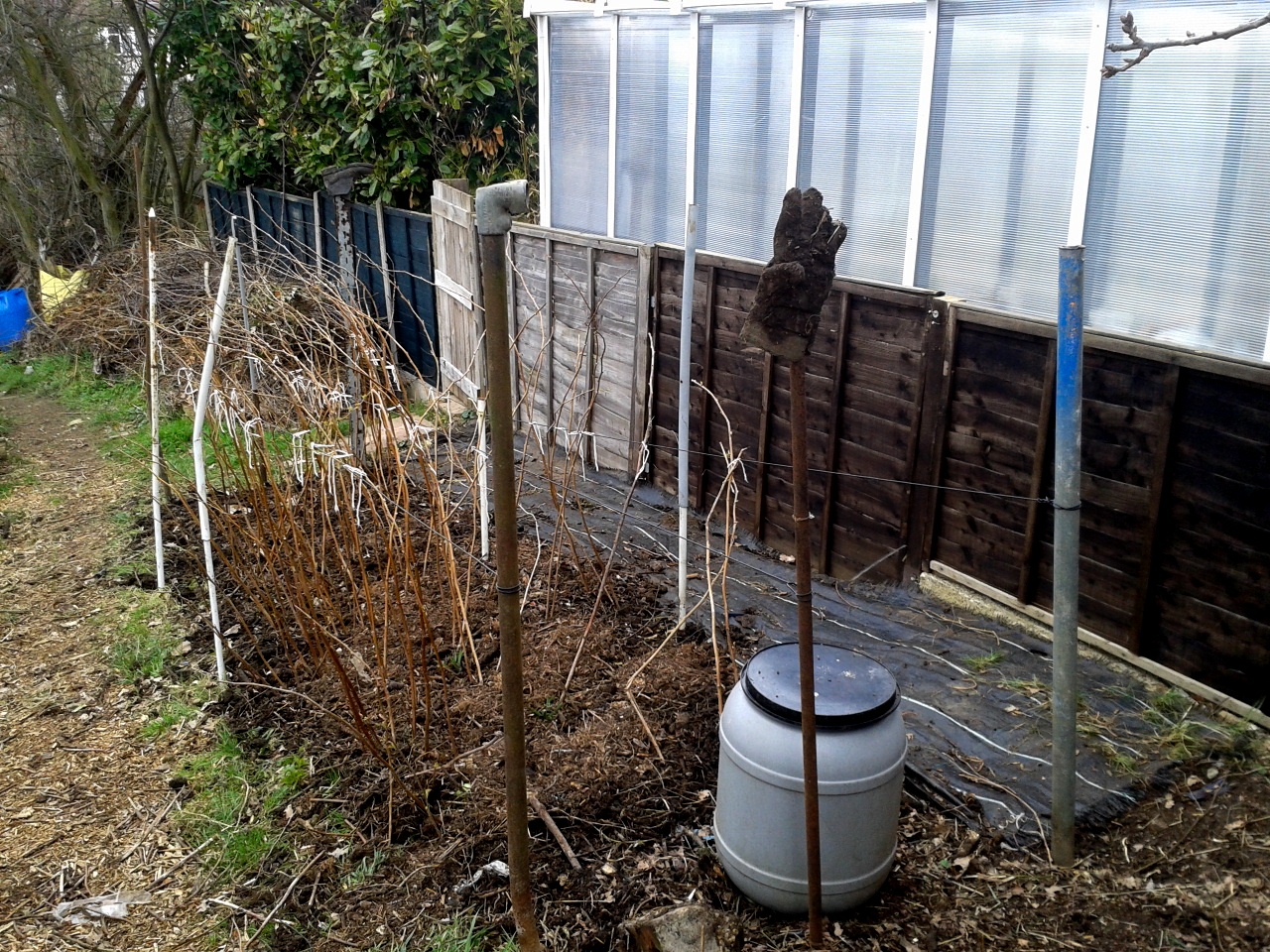
Raspberry Patch - mulched & trained

Leaf Mould & feed bins
Couch grass, bind weed, dock and dandelion roots removed from raised beds are soaked and rotted in the bins and then composted.

Apiary - forest garden.
It looks as if each colony has survived the winter, with the aid of fondant feeds

Forest garden - path - south side
The bramble patch was encroaching quite heavily into the forest garden making it difficult to access and, amongst other things, causing some of the fruit trees to grow back over themselves. The brambles growing into the forest garden tree layer were cut back. This created a path around the forest garden.

Forest garden - willow dome
Very slow to get growing this year.

Plot B - no dig potato patch
Plot B has been 'fallow' (unworked) for two years and this year we will attempt to reclaim the plot by growing potatoes in a compost/straw/paper/card mulch - in baskets, tyres and raised beds.


at home in the potted bean fields.

Sunday, 24 March 2013

Field Study's Man in E17 is ANXIOUS


Chitting Potatoes - 24th March 2013 


Allotment Plot B - Field Merz in Progress - March 2013

Field Study's Man in E17 is a hardy soul and he is not deterred from his weekly visit to the allotment by the persistence and tenacity of winter. 
The weather today is in such contrast to that of the same day last year. Here are some photographs from the archive to illustrate the difference. A warm sunny day, a willow in full flower, the bees collecting and storing considerable quantities of pollen and the queens laying well. It will be far too cold to look in the brood boxes today although we will have to make very quick inspections of the sugar fondant stores we have been providing to ensure the bees, confined by the cold, are not starving.


24th March 2012

FSMiE17 has been depositing his own eggs of a sort. You may recognize them as seed potatoes put in egg trays to chit. You would not be wrong however, in the field student's mind, they are also eggs; giant ant eggs, e.g.

We hoped we would have the seed potatoes ready for planting out in Plot B of the allotment - an area currently covered by a giant collage of cardboard, plastic and other materials - a field merz/merz field. The cold weather is forecast to continue right through Easter and so delay the planting of the main crop potatoes and consequently increasing the chance of blight later in the year. A summary of the psychological report for Field Study's Man in E17 for 24th March 2013 concisely states - ANXIOUS.  

Field Study's Man in E17 communes with culture and nature during his visits to the allotment. Today he will attempt to commune with Kurt Schwitters, Victor Grippo and, if there is space, Robert Rauschenberg. I suggested to the field student this would be a very blokey congregation - with a sort of dead white European male bias. Grippo was Argentinian, he replied. He told me he would try and address this bias. 

The purpose of the convention is to inform a field study emanation.

Friday, 22 March 2013

Field Study's Man in E17 kisses the sky and digs compost


10th March 2013


The first of the sown seeds have germinated in the centrally heated interior of 'Lost and Found in E17'. Their serpent like forms quietly and mysteriously broke through the fibrous surfaces of tangled dark composts and it has all been very compelling for Field Study's Man in E17. He frequently found himself setting out to do something and then distracted by, and so lost in, the unfurling motions of the delicate seedlings. Today (11th March), further afield in the great outdoors, beyond the warmth of home, a biting easterly wind bore swarms of stinging snowflakes; every flurry of them swirled about the new town centre of Harlow and put pay to the field student's premature thoughts of spring. Why, sometimes the swarms were not just of ice but also of blossom, both strafing the shoppers hurrying in and about the chill-some arcades. We looked up briefly into the skies above the Essex town and all we saw were the behemoths of westerlies and easterlies colliding; ominous masses of water and air in fallout.

I hoped that all the despoiling wintry gusts had not found their way into the allotment to reap havoc with the new and delicate spring blossom that can, if it were warmer and drier, provide essential early nutrition for the honey bees in the apiary. I was disappointed not to see the bees out of the hive and foraging among early flowering fruit trees. 

9th March 2013

Still, Field Study's Man in E17 and his fellow peasants were not completely disheartened by the mysterious movements holding sway way above and about their heads. Our minds shifted from the sky to the soil and a new raised bed to restore and revive. Here 'Bed 1' has overgrown with couch grass, as can be seen in the photograph below. The end of the bed was occupied by three compost bays made of pallets. Some of the pallets had rotted and so rather than try and dig over the couch grassy bed - involving the very laborious task of removing the rhizomes - we decided to rebuild the compost bays further along the raised bed. The earth beneath the former site of the compost bays would, we hope, provide us with a fresh, fertile and relatively weed/couch grass free section in which to cultivate a crop this year - possibly runner beans. 


Bed 1 - overgrown with couch grass - 9th March

Dilapidated compost bays - 9th March

A new bed in the making - 9th March

A year or so of composting on the new section will, we hope, give us more of the soft dark crumbly soil we so enjoyed discovering beneath the heaps - a bed into which we might plant dreams of some mighty bean stalks. 

Wednesday, 6 March 2013

Field Study's Man in E17 takes a lunch break with the bees.

Apiary Observation 5th March.

Tuesday 5th March
Was it the splendidly warm and reviving spring sunshine on Tuesday (5th) that set Field Study's Man in E17 to thinking about sex while we (me, myself and I let's say) explored the northern most reaches of Waltham Forest and beyond into Essex? I told the field student he must concentrate on the job in hand. Quite, he replied, and with that thought I realized his immersion in the new seasonal urges and surges was deeper than I initially surmised however I did manage to retrieve some mental capacity from the orgy of the field student's smutty preoccupations in order to continue our work. We plodded along to the sound of all our creaking springs of this and yesteryear and got the job done eventually.

Perhaps it was not only the sunshine that caused the field student's preoccupation with various types of reproduction. The previous evening we had attended a meeting of the East London Beekeepers (Elbeeks) at the Ferry Boat Inn. 'Elbeeks' is an informal association of beekeepers that meets regularly to share knowledge, experience and beekeeping wisdom.

Field Study's Man in E17 reproduces some knowledge
There was a discussion about how honey bees mate and reproduce. A new queen honey bee will emerge from a hive and fly a certain distance (about 50m. from the hive I'm told) and to a height where drones (male honey bees) are flying around waiting to mate. The drones may well have come from different colonies much further afield and so collectively they are the progeny of numerous queens. I have heard the area to which the queen bee makes her mating flight is referred to as, 'the drone layer'. The queen bee can mate with up to 15 drones and in so doing she collects enough sperm for a lifetime of nigh on relentless egg laying - perhaps for 4 years or more. The act of coupling with the queen is fatal for a drone bee and some might say this is a just outcome considering the life of egg laying slavery a queen bee will endure. Such sentiment may just be misplaced anthropomorphism.

If I understand correctly, it is the queen bee, back in the hive, which fertilizes the eggs with the sperm given to it by the drones during the mating flight. The beeswax honeycomb consists of different size cells (hexagonal shaped cavities) and the queen bee responds to these by laying eggs in some of them - and further, deposits eggs which are fertilized, or not, depending on the honeycomb cell type and location. A fertilized egg will produce a female worker bee, and an unfertilized egg a male drone bee hence a drone bee is a form of clone of the queen bee. I assume the sperm and egg unite within the queen bee as a sort of automatic response to the specific cell type into which 'she' is laying. It seems common sense that the sperm and eggs cannot unite until close to the time of laying because bee gestation takes place in the honeycomb. Does the queen only make one mating flight? I assume so, and thus if so the sperm she/it receives have to last or live 4 years or more. I think this is a remarkable phenomenon especially when considering the possibility a queen bee may only find drones from her own colony to mate with. That is not a desirable situation in terms of the long term well being of the honey bees.

and laments his host's pragmatism
I wanted my host, Julian Beere, to lose himself completely in the wonders of honey bee reproduction however he insisted on occupying a less enlightened state of mind. He told me that the season of mating flights and swarms is not yet upon us and therefore we might do better to focus on matters closer to the present - like keeping the bees nourished until the cold wet weather is well and truly gone. Starvation is a problem for bees at this time of year as brief spells of warm weather stimulate a lot of bee activity for which a lot of energy is needed - at a time when honey stores may be low and there is relatively little nectar in the early spring flowering plants.

We heard a rumble and feared the weather was going to change abruptly however the rumble was actually our tummy grumbling at the lack of a lunch break and being so close to the apiary we decided to go and have a late lunch with the bees.


 Crocus - 5th March.

We observed the behaviour of honey bees elsewhere on the allotment, in particular, their gatherings about the watery margins of ponds and swales.


Back at Base Camp Beere, Field Study's Man in E17 explored some of the visual qualities of bee hive activity through the lense of Windows Live Movie Maker  - repeatedly smudged solarizations being the basis of this representation.

Apiary 5th March 


Sunday, 3 March 2013

2013 Seed Collection

Achocha - GS2006 - seed swap
AUBERGINES - LONG PURPLE
BASIL - SWEET GENOVESE
CLIMBING FRENCH BEANS - Barlotta dwarf
- Neckarqueen
- Neckagold
BEANS - Cherokee Trail of Tears
BEANS - RUNNER - SCARLET EMPEROR
BEETROOT - GOLDEN DETROIT7
- BETTERAVE POTAGERE Plate d’Egypte
- Perfect 3
- Detroit 2 Globe
BROAD BEANS - GREEN LONG POD
- Hangdown Green
PURPLE SPROUTING BROCCOLI - EARLY
BRUSSEL SPROUTS - RUBINE
CALABRESE - BELSTAR F1
Carrots - Early Nantes
Catmint - seed swap
French Cauliflower - Romanesco Precoce – seed swap
CHARD* - Canary*
- Rainbow*
CHICORY - GRUMOLA VERDE
Crimson Clover - green manure
CORN SALAD - VIT
Cosmos - flowers
COURGETTE - NERO DI MILANO
CRESS - AMERICAN LAND CRESS
CUCUMBER - MARKETMORE
Dill - seed swap
Field Beans - Green Manure
French Marigold - flowers
Green manure mix - seed swap
KALE - WESTLAND WINTER
LEEKS - ALMERA
LETTUCE/salad - ORIENTAL MIX
Mustard - White – seed swap
Orache - Red - Seed swap
PARSLEY - ITALIAN GIANT
PARSNIP - AROMATA
PEAS - RONDO
- Heritage Pea - seed swap
PEPPERS – HOT - RING O FIRE
PEPPERS - SWEET - YOLO WONDER
Phaci - green manure
RADISH - CHERRY BELL
RADISH - WINTER - BLACK SPANISH ROUND
ROCKET - RUCOLA
SPINACH - Giant Winter*
- Bella F1*
- Atlanta*
SQUASHES - Red Kuri
- Winter Squash
- Butternut Hawk F1
- Buttercup
- Loki or ‘Long Melon’ – gourd
- Kudu, small round gourd
SWEDE - LOMONDE
SWEETCORN - TRUE GOLD
TOMATOES - Gardeners Delight
- Yellow Submarine
TURNIP - GOLDEN BALL