‘Field
Study’s Man in E17’ has been in a funk recently and has been trying to walk
through and out of some of the darker atmospheres of his morbid state of mind. Here
are some images from a psycho ‘snappographic’ circumambulation undertaken by him one evening earlier this week. The walk took in a perusal of the
Hoe St Co-op skeps before a visit to the entrance of Queens Road Cemetery, and
then on to other sites of earthly or rather saturnine remains.
There is an
obvious funereal connection between Alstron House, the location of the
ornamental skeps, (‘Co-op funeral care’) and Queens Road Cemetery. That burial
ground is now full, according to the council web site. There seemed to him to
be a disparity between the coffins on display in the showroom and what he thinks
are the usual ethics and values of cooperatives/the cooperative movement. He
contemplated the various costs of the great inevitable while walking down Queen’s
Road, by streets most likely named after some of Queen Victoria’s children, (Leopold, Beatrice, Helena...) all
of whom are long dead.
'Field
Study’s Man in E17' is on the trail of a ghost story. In his forage for spooky
themes and ideas that night he found himself among chthonian bees, the
melissae, sent down from the moon goddess Artemis. By day, the bees are still,
suspended, stucco in, of and about her skeps. By night and the chill moonlight they, as disembodied souls, are released to transmigrate and forage along
the old ways, amongst the carved and moulded ornamental flora, of Walthamstow.
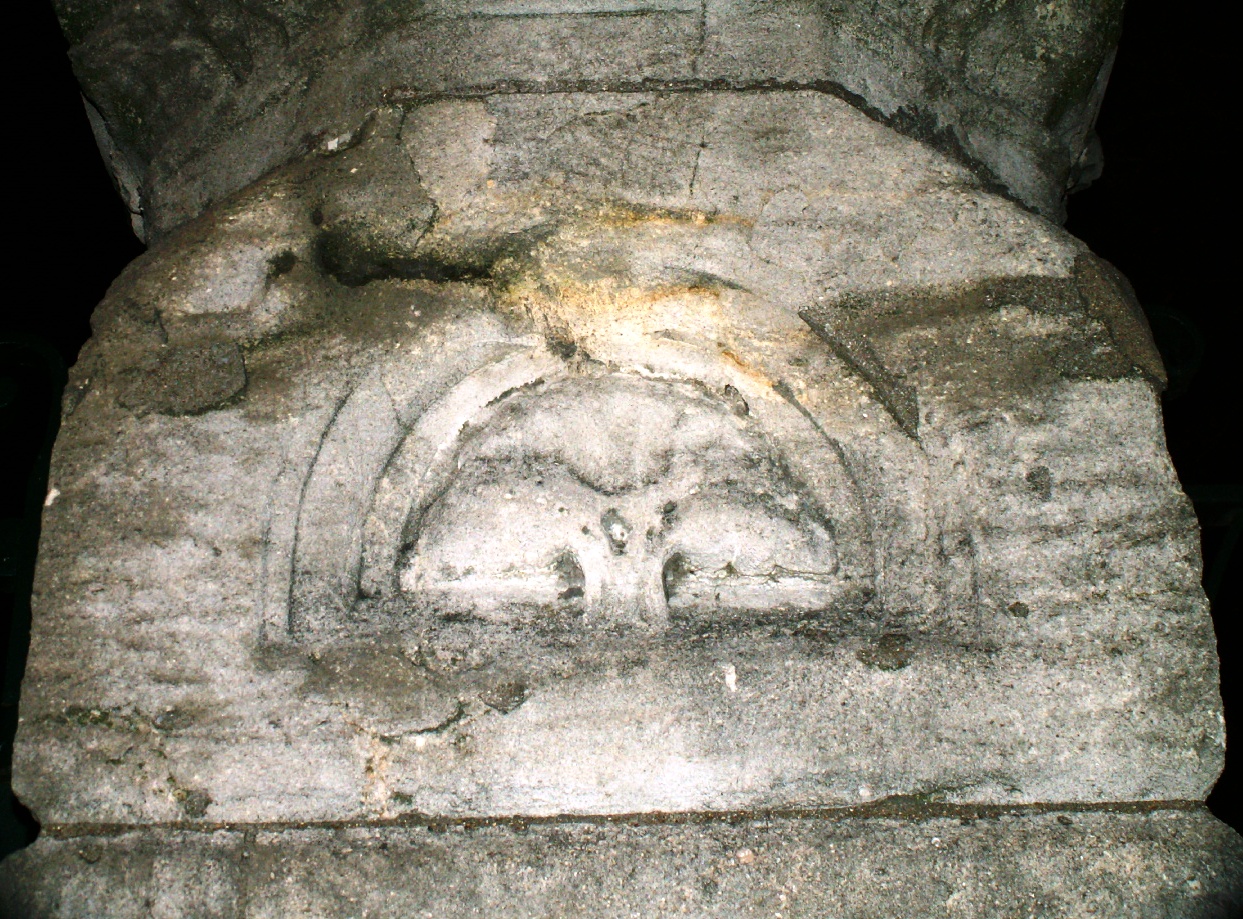
The stone
gate posts to the cemetery are eroded, the tree motifs substantially diminished
since their installation in 1872 (?). Could the motifs be ornamental renderings of yew trees and might that be a yew tree next to the entrance? If that is a ‘living’
yew at the entrance, might it have been a Victorian (or later) planting, an
indulgent harking back to ancient burial lore?
From Queens
Road, 'Field Study’s Man in E17' followed the drone of one of the sepulchral bees
down towards St James Park where, nearby, other sorts of remains were to be
found.
Further on and a browse of the Oxfam book window found the field student looking at a paper- back copy of
Charles Palliser, The Quincunx. What sort of coincidence was it that the
field student had just finished reading the first chapter of W G Sebald’s,
Rings of Saturn? In that chapter, Sebald cites Thomas Browne’s demonstrations
of, or allusions to, ‘the elegant geometrical designs of Nature’ (quincunx), as
well as his investigations into funeral rites leading to discourses such as, Hydriotaphia or Urn Burial 1658, in which he observes, ‘the
(pre-Christian) funeral pyres were built of sweet fuel, cypress, fir, yew, and
other trees perpetually verdant as silent expressions of their surviving
hopes’.
Bee Wilson, in her story of the honey bee and us, The Hive, tells of how Jean Jacques Rousseau believed that honey hunting was a basis for a more democratic and equitable society, that 'a culture of gathering honey from mountains and hollow trunks of trees' necessitated a justice and good faith that are the antithesis of the ethics and morality of 'large, decadent, sugar-eating nations'. So it was on a very decadent Saturday afternoon I indulged in a solitary walk about Walthamstow in an attempt to make more connections to or with the Co-op beehives on Hoe St. While my feet trod the paths of E17 my mind wandered variously further afield.
While out walking this evening I revisited another old co-op sign, this being the ghost sign on the side of what is now the Casanova restaurant on St James St. The photographs above were taken last year and since then the cables, if I recall correctly, have been removed. Earlier in the walk I came across another ghost sign at the bottom of Jewel Rd. It may also be for a co-op.
It was an evening walk for signs of other sorts as well. This is the first time I've come across these projections in light for South Grove and the High St. I assume they are a part of the redevelopment of the South Grove (car park) area courtesy of 'South Grove Regeneration Walthamstow Ltd'. 'SGRW Ltd' will facilitate the arrival of a 'tailor made for Walthamstow' Morrisons into the town centre. Is another supermarket really needed here?
More details about the council's involvement in this are here
A more critical appraisal of the project from Waltham Forest Civic Society is here
I like the idea that something more than half the 230 apartments will be affordable - presumably to plebeians - and that the remaining apartments will not be affordable to ordinary working people on low to middle incomes but affordable to .......?
When I snapped out of the discombobulation induced by the quirky skew-whiffery of the South Grove illuminations my attention was drawn to the mysterious inscriptions on the pavements. Perhaps they are the beginnings of the improved cycling and walking links to the town centre?
I hope that these improvements will be fit for purpose and resilient to the increased volume of service and customer motor traffic - and that this sort of conduct, as reported by Freewheeler, will not be possible let alone tolerated.
I've started to wear a helmet cam to record some of my cycle journeys, particularly my commute to and from work; Walthamstow to Bermondsey. I sometimes do my work, delivering and distributing leaflets, by bicycle (when I can carry the load safely) but for a greater proportion of the work I use a small van. I think I have a motorist's and cyclist's perspective of conditions on the road - as culturally and cognitively dissonant this may be.
I'm not sure I actually like wearing the cam considering the connotations of surveillance, voyeurism and narcissism about it. Recently I was hit by a car and did not react to the incident so well and so thought a cam might be a tool useful in defusing some of the anger and frustration I feel at the design of and conditions on London's roads. I haven't yet used the cam to record my van driving.
I'm inclined to agree with Freewheeler (Crap Cycling and Walking in Waltham Forest) that the design of the roads makes (vehicular) cycling and motor vehicle use nigh on incompatible. I've been cycling in London for nearly 14 years (cycling for 40years) and despite some high profile, though largely cosmetic, cycling 'innovations', cycling does not seem any easier and more enjoyable. The same goes for driving in London. I am sceptical about claims that more people cycling in London will improve the situation. Some of the claims seemed to be based on statistical jiggerypokery as much as my lay persons understanding of statistics can justify that viewpoint. Of course a huge critical mass taking e.g. Tower Bridge, might make for a safer cycle crossing but how would a relatively huge 10% or 20 % increase (over what period?) make that a safer bridge to cross? Would the '20%' arrive at the same time to form an ultra resilient cycling phalanx capable of shoving wayward juggernauts out of the way? I realize this is a partially flippant comment about a complex issue but looking at the recordings I've made in the last few days has reminded me of just how horrible some places in London are for cycling. Tower Bridge/Tower Bridge Rd is one example.
The logical supposedly sensible answer is to find a less congested and hazardous route and/or time of day to cross and not be, as some persons have said to me, a victim or even a martyr! Crossing London's bridges safely by bike is difficult.
Some cyclists appear to have adopted a more 'zen' approach to navigating the capital's bridges, rendering themselves immaterial and thus capable of extraordinary feats of survival
The clip below (top) was filmed using a helmet cam late afternoon on 24th Sept. I was standing with my bike at the corner of Tower Bridge Road and Tooley St, waiting to cross at the pedestrian crossing. .
Here I was at the Bakers Arms studying the advance stop line there and the improbable lightness of being a double decker bus. It really is crap there but, of course I don't have to use that junction.
And here at the junction of Southwark Park Rd and Drummond Rd in Bermondsey, a clip of an encounter that is a little bit vague but recalls how a motorist has chosen to overtake me as I begin to turn right, making, I assure you, a very clear hand signal having positioned myself in the centre of the road. Listen to that acceleration! Phew, thank you for missing me!
Every Day is a Good Day
日日是好日
"Everyday is a good day." (Nichi nichi kore kõjitsu.)
Walthamstow Central Library has a copy of, The Forgotten Arts and Crafts, written by John Seymour and first published by Dorling Kindersley in 1984.
Here are some library references & links to, The Forgotten Arts and Crafts.
John Seymour along with the brilliant DK design team produced a fascinating compendium of arts and crafts remembered through an accessible writing style illustrated by a wealth of drawings and photographs including archive photographs. Some of the content may be nostalgic and sentimental e.g. the colour pencil drawing of a Victorian kitchen (p.206-207), however this does not necessarily detract from the book's usefulness in finding out more about the Hoe St, Co-op skeps featured in the previous post, Field Study's Man in E17 photo forages.
In that post I commented, via Wikipedia, that the use of skeps involved killing the bees if honey was to be harvested. Seymour includes beekeeping in the tome and suggests a method of skep use that does not destroy the resident honey bee colony. A skep full of bees and honeycomb is carefully turned upside down and an empty skep placed on top of it. The bees are supposed to move upwards into the empty skep leaving a less bee-ful skep from which honeycomb can be taken with less detrimental effects on the bees. Seymour commented that he had 'never done this' but had been 'assured that it works'. (p.173)
When (at what time of year) would a skep beekeeper do this and how long would it take? Would the honeycomb only be partially harvested and the remaining comb given back to the bees by reversing the process?
To complement John Seymour's recollection of skeps, there is this excellent video sourced from Youtube about the making of skeps; an art and a craft not so forgotten going by the number of videos uploaded to the site. There is a sense of careful stage management and theatricality about this demonstration; the light and spaciousness of the set, the sparseness of the interior, the costumes of Fritz and August, the absorbing measured pace of the narration with pauses to allow the deft hands 'to do the talking' - quite dreamy if not surreal.