Tuesday, 4 September 2012

a field study of a psycho-garden party

Day 1 on Day 4 of the E17 Art Trail. 


What would you make of this?
.
Imagine you are visiting Vestry House Museum garden for an evening of site specific performance. It is a balmy late summer evening, the sun lowering to the horizon creating an ambrosial light. You come across a woman walking between two golden bowls situated at opposite sides of the empty pond like feature made of grey granite like stone. From one of the bowls she gently scoops a milky liquid with her cupped hands and proceeds to carry the liquid, walking slowly to the other bowl into which she pours that which has not leaked between her fingers and dribbled down her front and to the ground.
She is dressed sombrely – dark purple black garments, a smart tunic top, a heavy ankle length skirt and very plain black shoes. Is she in mourning? Some of the dribbles of ‘milk’ seem to stick to her like drips of wax on the side of a candle. Her repeated traversals have a meditative rhythm. While returning to the fuller bowl she holds her hands together close to her chest, her head dipped towards them, as if she is absorbed in prayer. Other visitors or audience members pause to watch the modest spectacle. She continues oblivious to the gathering onlookers, serenely engaged in her task despite some occasional audible vocal dismissals of what is (a) happening.
.
Would it make you think about mythical characters who are condemned to repeat tasks for an eternity, only able to stop if something impossible and unthinkable happens; e.g. the eternal torment of Prometheus whose liver is pecked away by an eagle by day only for the liver to grow back at night and have it pecked away again, ad infinitum. But the scene at VHM involved a woman and what was probably a finite supply of ‘milk’. Whose ‘milk’?
.
‘Floraphilia’ consisted of several timed and durational performances between 5pm – 7pm. The ‘milk lady’ was I think, Liz Kumin performing ‘Kenophobia’. Most of the audience kept a conditioned distance from what might otherwise be considered futile, disturbed and manic behaviour. If this was real, at some point the apparently spellbound woman would probably have been discovered by museum staff and consequently led discretely away by people who used to be referred to as ‘men in white coats’. But the sun’s descent seemed to slow if not halt and the drips of artful milk thickened as if to hang from the fingers and there was a moment of pleasantly dreamy suspended disbelief.
How would you interpret that encounter along with several others similarly odd happening around the garden? From what state of consciousness and/or sub consciousness had the acts and images come and how would the encounter with them act on or in your subconscious? When you or I go to an art event how immediately do we have to ‘get it’ and ‘get into it’?
.
‘Dreamy suspended disbelief?’ Well all most, because some bloke with a big camera, seemingly ignorant of the audience, invaded the dream space. Those potentially hypnotic sounds of ‘self contained’ trickling milk were drowned out by the intensely irritating noise of his shutter and motor drive, aided and abetted by the drone of police helicopters flying nearby over Forest Road. His hurried pacing to and fro in the space between the performer and audience was completely at odds with the subtlety of the performer’s movement. Was his incongruous presence a scripted or choreographed part of the act? I wanted him to go away and become a permanent personal photographer to that mythical eagle. I assumed the photographer was invited by the artists to photograph their performances and doubtless his interventions will have produced some lovely images, but to the detriment of any sensitivity towards the performance. If he was, I think it was a crass approach to the documentation of the event.
.
The contemporary phenomenon of anything and everything (it seems) being photographed and videoed as they are happening, often by the people of the happening, is perplexing. Narcissism seems to have created a sense of a lack of authenticity about experience; if there isn’t e.g. a photograph of an experience that experience very nearly ceases to exist. The experience has not been validated. Later in the proceedings the narcissist and voyeur within me got the better of me and got my camera out and snapped away in a vain attempt to capture moments of release of paper planes thrown by a mysterious woman wearing a flowery mask.  lili Spain, in ‘Garden of the Hesperides’ attempted ‘to ward off insanity, using the power of the psychoanalytic word’. I remained seated and used the camera zoom to get closer and I’d turned the digital camera’s faux sound effects off. He was there again and some interaction ensued between him, other photographers and the paper dart throwing lady of the raised bed. She appeared to aim the planes at the cameras and this was cause for some amusement in the audience, perhaps recognising his obtrusive presence.
When a couple of the paper planes floated and glided down close to me I picked them up and unfolded them to discover they were pages torn from, ‘The Interpretation of Dreams’ – Sigmund Freud’s classic treatise. Perhaps other eminent psychoanalyses flew about that evening – Lacan, Jung, Freud, Anzieu and others, each riding the breeze that also gently rocked golden apples hanging as if suspended in mid fall from a nearby tree. I think the planes and pages were most likely all a scattering of Freud’s interpretations. One of my pages explored ‘the space between (my?) sanity and madness, truth and myth’ via some words about wish fulfilment, infanticide and coitus interruptus – the latter considered by Freud as ‘one of the factors responsible for the development of neurotic fear’.
.
Later, a woman walked round and round the golden apple tree plucking, eating and dropping the petals of a bunch of white roses. She left a ring of blossom on the decking around the base of the tree while a macabre masked figure with bizarre facial appendages; mechanically flapped insects (perhaps dragonflies), walked by. When she and it had departed, a gentle breeze carried the petals away and Floraphilia, in situ, ended for me.
The garden was a sort of sanctuary or retreat particularly in the context of the charged atmosphere around town with the marches, demonstrations and traffic congestion. Gardens can be used therapeutically, as healing places where people can maintain, restore and develop personal and communal equilibrium. VHM’s community garden has, I imagine, enabled some people to deal with various problems or neuroses, consciously or otherwise. The Floraphilia performances as a psycho-garden party did not suggest to my superficial knowledge of psychoanalysis, and perhaps insensitivity, any disturbing psychosis and/or neurosis*. Right now, back in the garden in my mind, the helicopters are droning overhead monitoring the movements of various extremists, and causing me to think about the recent trial of Anders Bering Breivik, and the task of deciding if he is sane, having committed the atrocities he did, and what the verdict means and what can be done about that sanity.

.
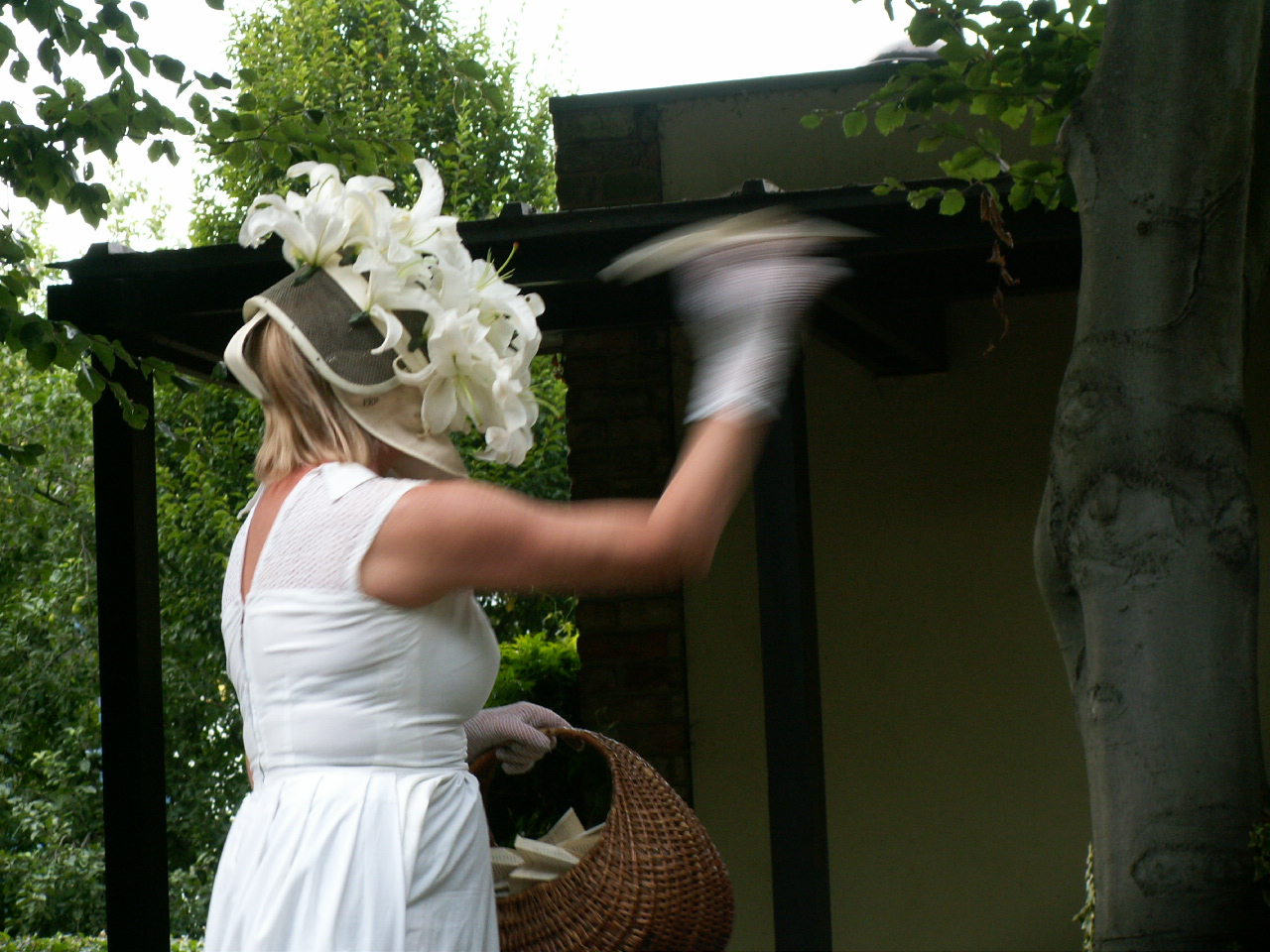
Floraphilia
Part of the E17 Art Trail 2012, Saturday 1st September, 5-7pm.
Two hours of surreal and absurd live art & performances at Vestry House Museum, on the opening night of the E17 Art Trail.
Curated by Folie a Trois - www.redvelvetcurtaincult.org

.
.


* - I found this website helpful - http://www.guidetopsychology.com/psypsy.htm

Sunday, 2 September 2012

a field study of thinking one is a gift to the E17 Art Trail 2012


Our annual festival of local creativity, The E17 Art Trail, has started. I have studied the guide to this ever expanding field of artistic bestowal and I am wondering how I can, as a visitor, do the collective emanation justice. The trail has grown to such an extent there is probably no way of taking it all in. Indeed any attempt to do so might be considered superficial and a discourtesy to the gifts of the organisers and contributors. There is the risk of becoming a Mr Nasty, he of ‘Pythonesque’ gluttony, who kept on demanding more and exploded before he could even contemplate expending some of the energy of those gifts heaped upon him. If every listing is an offer of a gift then the prospective visitor has to decline many of the offers and hope that no offence is given and/or taken by doing so. I know from having been a contributor to each trail (from 2008 to 2011) that I wanted my offerings to be accepted, taken and relished in a variety of ways, each involving the investment of various energies on the part of giver and taker – and in such acts of artful bestowal giving and taking are not necessarily fixed roles.

This year I am not contributing to the trail as an individual listed artist and I have also not collaborated with artists groups as I/we have done in previous years.  There are numerous reasons for my lack of participation however I doubt they are of much interest to this year’s E17 artists and audience – a potential outing that looks anything but diminished by my lack of presence. I had entertained the idea of Martin Creed like sprints through art trail venues. Despite the appeal of the alternating togetherness and loneliness of long distance artiness, that antic risks doing some considerable and unwelcome damage literally, metaphorically and symbolically. Obviously a lack of some original thought can explain my contributing absence although I was still to be found late on the night of 31st August, E17 Art Trail Eve, busily preparing an art trail itinerary, my participating presence – ho ho ho. Last year I vainly published a list of potential visits but this year my visits are supposed to be surprises. How did our first day unfold?

 Walthamstow Awaits - the EDL and anti EDLs are coming.
Forest Road


Day 1 was a challenging day to set out on the trail given the presence of the EDL march and the counter demonstrations. In the morning I had doubts about being out and about in Walthamstow for fear of the potential confusion, hysteria and violence that can be generated by extreme racial and political prejudice and intolerance. It was not only the belligerence of the English Defence League I feared but also that of opposing factions intent on similarly violent confrontation. I ventured into the town centre to do a few errands and to test the local water so to speak. Walthamstow Market, High Street expresses how multi racial and multi ethnic this town is, and how peaceful the interaction of the diversity is most of the time; something to admire. I was encouraged by the art trail hub at the library and decided to set out on the trail in the afternoon.
My planned route and itinerary was thus – 2 to 38 to 100 & 101 to 123 to 23.


A gift of the allotment - August 2012

2 – The Bank of Walthamstow
One of the reasons/excuses for my non participation as a listed artist is lack of funds. I thought I would start off my trail with a visit to a truly local bank manager to seek a bit of quantitatively easing E17 dosh to finance some artful visitations. Anticipating a demand for some collateral I rustled together a bag of surplus fruit and vegetables harvested from the allotment. Of course I was not going to tell the manager it was surplus. I hoped my hunger (for art) would be considered valuable enough for the loan of some notes for which I would also promise to visit at least all those venues and artists listed above. I also hoped the visited artists might exchange items for those notes and so stimulate the currency of the Bank of Walthamstow. I imagined myself as an E17, J S G Boggs like character as brought to me by the 1992 documentary, Money Man, directed by Philip Haas. Unforgivably, as an E17 field student, I failed to read the small print of the listing properly and when I arrived at the Bank of Walthamstow I discovered the bank was not yet open to the public. The prospect of a career in E17 merchant banking did not look good. I promised to return and left quickly in case the warm weather might cause my vegetable commodities (by which I also mean my reserve of brain cells) to depreciate further.

 Venue 100 - Arts and Crusts, Victoria Rd

Original Army - Peep Show Curiosities


.


Still Life in Sugar by Sarah Hardy.


100 – Still Life in Sugar – by Sarah Hardy / Comics from East London by Paul Francis / Peep Show Curiosities

Field Study’s Man in E17 is very good at getting lost in E17 due to an increasingly accomplished ineptitude in map reading. Are there no limits to his – ok – my incompetence? Instead of 38, it was 100, the Arts and Crusts Cafe, where I found myself next, lured no doubt by the finely honed skills of art cafe proprietor, curator and barista, Andrew.

Another reason for my non participation this year is lack of honey. Our honey bee colonies have barely made sufficient stores to feed themselves over the autumn and winter months let alone supply the sweet teeth of us weird white and smokey things called beekeepers. In each of the art trails from 2008 to 2011 I have used honey as a sort of art material to express a variety of ideas about place and belonging. The lack of a honey harvest this year leads to an analogy of a painter being asked to paint without any paint.

Andrew and I exchanged the bag of fruit and veg’ for a cup of roasted Arabica(?) and with that essential stimulation I set about consuming Sarah Hardy’s wonderful cake come icing sugar sculpture. I paused to savour the promise of the bit of the stag beetle I would bite off and gobble first. The beetle was having none of this bitter sweet vanitas and scuttled off out of sight leaving me with the caterpillars, snails and assorted fruity momento mori. In my mind the beetle found its way into the glazed peep show arenas of Original Army where spectral circus performers concealed curious crepuscular goings on. I was wary of exposing my eyeballs up close to the diabolus within and shifted my attention to comic capers of a different sort.   

I found myself in the more bucolic company and territory of Joseph Tredgold as remembered by comic artist, Paul Francis, in 'A Pupil of Nature'. Paul’s sparing monochrome pen and ink style rendered the possibly fictional but definitely comic Joseph Tredgold as a Walthamstow based experimental field student of looking and drawing. Where do you have to go and how do you have to position yourself to represent the truth /the Truth, of nature?  Mindful of Paul’s cautionary graphic tale I decided to leave the procumbent Tredgold in the cafe and locate myself standing upright in front of a homely, harmonious and orderly composition as provided by the delicately tonal scrutiny of Sarah Hardy, and the kindness of her hosts, Andrew and Carol.

101- The Hand Drawn Wallpaper – Sarah Hardy

Across the road from Arts and Crusts in Andrew and Carol’s house there was suspended above and on the wall space of the front room fireplace a host of finely drawn insects, insect bits and other miniature beasts. The fragility of the creatures was recreated in pencil on a fine white paper used as wallpaper, their variously broken and otherwise decayed and depleted bodies explored through different points of view. The gentle fall of the ghosts, the traces of insect shades, had a slightly disconcerting presence in the homely setting of that private and personal room adorned with more colourful and robust memories. It had a resonance with the vanitas work displayed in the cafe. I did not want to outstay my welcome nor stray from the Sarah Hardy trail of arthropod body parts and so left a busy Arts and Crusts to find the source of the insect fright.  

38 – Broken Bees, Bugs and Birds. Drawings by Sarah Hardy.

This venue was Sarah’s garden studio space where she practices her crafts. It seemed to be a quiet place but for the intrusive drone of the police helicopters overhead tracking the march and demonstrations nearby. There was some talk of how people, particularly families with younger children, might have been put off doing the art trail in the area because of the risk of trouble by the march. There was an array of studies, closely observed and absorbing still lives to see, each reproduced in various graphic media from original pencil drawings to limited edition litho-prints. There were also Sarah’s collections of insects and her tools to examine them. Looking in what might have been a cigar box full of insects dried of life, my thoughts were cast back to earlier in the day when I had visited one of those small booths on the high street market to try and get my watch strap repaired. There seemed to be a poetic comparison to be made between the watch-smith patiently picking through a tub of tiny watch parts with tweezers and that assortment of insects bereft of their parts. I gave Sarah the hornet I retrieved from a bee hive earlier in the year, as a gesture of appreciation for her contribution to ‘my art trail’ and then made my bumbling way to Vestry House Museum to see ‘Florophilia’. 


from, Florophilia. Curated by Lili Spain and Sarah Grainger Jones at Vestry House Museum.

Coming up next:

Day 1 dreamed on into Day 2.


Monday, 27 August 2012

a field study of ants and their underestimation

The Archipelago of Truth offered some advice about the value of red ants recently - suggesting curry their eggs. I thought the next time I have scale shifting size of ant egg moment that advice will be very useful. Earlier this evening a particularly daring red ant found its way into one of my ears. I didn't care about what the ant was trying to tell me and quickly dug it out. Of course what I really needed was a green woodpecker to perch on my shoulder and pick off any ants intent on getting to the most precious of my woody materials.

A particularly fine specimen of a green woodpecker can be found over in the Archipelago. My advice to any woodpecker with a predilection for ants is, don't underestimate them. Bernard Werber's, 'Empire of the Ants' has an account of how a foolhardy woodpecker met a very grisly end via a multitude of very snappy mandibles.

'Soldiers then entered the head, looking for the opening to the brain. A worker found a passage, the carotid artery, which led from the heart to the brain .........' - and so they continued.

I retreated from poly-tunnel tomato picking and headed for a potato harvest. 


I thought these were potatoes however as the ground began to rumble and the birdsong was drowned out by a cacophony of gnashing mandibles I realised I had disturbed a giant red ants nest. Remembering Technomist's advice about red ant curry, I opportunistically grabbed a few of the eggs and legged it, hoping I would escape their vicious clutches and make a giant red ant egg-aloo. Giant red ants do not take kindly to their eggs being stolen for curries and one ant pursued me with terrifying determination. Even when I jettisoned one of the eggs the ant did not let up the pursuit. I thought all was lost as the air just above my head was vibrated by the frantic myrmedon gnashings. Then another sound or vibration filled the air and with a terrific whoosh an exquisite dragonfly swooped down and crunched the petulant giant red ant away.

Dragonfly at the allotment, Sunday 26th August 2012

Sunday, 26 August 2012

a field study of looking for a swim in the Lea


I enjoyed reading Gareth Rees’ tribute to an irrepressible and rebellious River Lea. Gareth searched for the preternatural spirit of the river and shared not so much an elegy but a homage and affirmation that counters some of the gloomy outpourings and discharges which have dimmed the vision of that sibling tributary of the Thames.
.
In Gareth’s mind the Lee retrieves herself as the River Lea at a weir near Lea Bridge Road, just a relatively short distance before a reunion with the mythic darkness of the Thames at Leamouth; one of many confluences in the great water cycle.
.
Rivers have a profound place in the human psyche. Gareth comments on his dedication that the River Lea can be equated with a post industrial psychosis; that is, a severe affectation of the perception of external reality. He publishes, via Scoop, an online magazine which presents a fantastic discourse on psycho-geography; that disciplined and/or un-disciplined study of relationships between mind and place. Much of the scooped discourse is land based. My perception of this has been formed by reading Robert Mcfarlane’s, The Old Ways. Macfarlane describes journeys made via ancient sea and water ways kept alive by uniquely passionate and courageous spirits. He proffers a theory that the predominant land based perception of place comes as a consequence of the Roman Empire’s military conquest and domination by road (across land) which often involved the subjugation of water by drainage, bridging and viaducts. Mcfarlane suggests we can subvert this dominion, or ‘terra-centricity’ (my term), by returning to water (the sea) to discover new and lost cultures of place and belonging.
.
Walking is often the default means of psycho-geographic communication or communion. In Mcfarlane’s aqueous return, sailing is a way to be more mindful of places which will not hold any physically tangible sense of a person’s passage. Mcfarlane came close to walking on water but maintained a grip on some sandy shallows of tidal reality enough to find his way to shore and retell the salty tale. He remembers his friend, Roger Deakin, a visionary proponent of wild swimming who wrote Waterlog, an account of a wild swimmers journey through Britain. Deakin proposed ‘dry land is our problem’ and that bathing and swimming can bring about a transformation in us, from Homo sapiens to Homo ludens, from neurosis to playfulness. Sadly, Deakin can also be found weeping while sitting less than playfully by the Bury St Edmunds Tesco, on the banks of the Lark; the humiliated ‘Jordan of the Fens’, a river reduced to a dribble and trickle of near irredeemable public convenience.
.
Is the Lea a convenience? Would you or I swim in it? I wouldn’t because I think it is too polluted, harbouring microbes via effluence which can transmit diseases causing extremely distressing psychosis and physical debilitation – post industrial or otherwise. The same day I started reading the ‘Swimming with Eels’ chapter in Waterlog I’d swum at Stanford Lock on the River Ivel Navigation. The swim of the pond beneath the long gone mill was charming; a gentle flow and tow of a depth I could just about reach standing with outstretched toes before I submerged entirely. The weather was balmy. The scorching sun was partially obscured by clouds drifting slowly above and between. Their flowing reflections were refreshingly cool. With each launch into the floating clouds, from the shallow margins to the deeps, I made unpractised strokes of the breast, crawl and back. I like to think time dissolved and washed away as I relaxed gently treading the currents. I fear I would not find this ease in the Lea.
.


Stanford Lock, Bedfordshire, August 2012
Later on, while lost in dead end circumambulations on and adrift from the Navigator and Kingfisher Ways, time caught up with me and started rubbing at my sweaty heels and toes promising blisters. I headed home, content with my amphibious exploration. Later, after dinner and a cool foot soak, I returned to Waterlog and the multifunctional advice the Environment Agency gave Deakin following an enquiry he made after swimming in the Lark at Isleham, where river baptisms had once taken place. The cool refreshment of my swim and soak then transformed into a hot prickling flush of fear as the advice reminded me of the hazards of swimming in rivers where sewage is a problem.
.
Deakin, to some extent, decried this officially sanctioned lack of faith in a rivers natural and cultivated ability to clean itself. For many rivers, and their people, water borne diseases are a prevalent threat and condition. Much psychosis, disablement, and mortality can be associated with dirty water. Deakin’s passionate and embodied knowledge of river histories enabled him to identify industrial pollution by synthetic, or alien, substances as a greater cause for concern. There is shit and there’s shit. The River Lark was severely poisoned in the late 1980s by a leak from a sugar processing factory; a bitter sweet poisoning made worse by the concrete containment and brutalisation of the river; a psychotic situation familiar to followers of the Lee and Lea. But this is a gloomy discharge; a fretful immersion in thoughts of water diseased with microbes and their ominous incubation periods. My self concern is about a situation for which many people make much more practical and outward looking efforts to remedy, inspired by hope that a river is rarely entirely lost and that the joy of water can be found again.


Stanford Lock - Reconnoitre

 
Outdoor Swimming Society tips - here

Friday, 17 August 2012

a field study of wasted energy

I'm currently recouping energy (or energies) in the pleasure fields of central Bedfordshire; Bunyan country. I have enjoyed a week of lazy mornings, reading and listening to the radio, followed by more physically energetic forays into the surrounding countryside, cycling, walking, fishing and swimming.

Yesterday I listened to Radio 4, You and Yours, which featured an article about some residents of Walthamstow whose homes are being shaken by freight trains using the nearby Gospel Oak to Barking line. If I recall correctly one of the rail officials interviewed stated the frequency of freight train journeys on that line has increased, as has the torment of some of the rail side residents.

A while ago there was some speculation that nuclear waste prevented from being transported via the North London line, for the purposes of Olympic site security, would be transported via the Gospel Oak to Barking line. I don't know if this is true however there are, it seems, ways of identifying trains carrying spent nuclear power rods.

The routes of the rail lines can be viewed here and here and here are some other links about this subject:

Local press reports -


Games Monitor


London CND Nuctrain Map


No Nuclear Trains


Will I go trainspotting when I get back to Walthamstow? Perhaps it would be wasting energy? In the meantime Bunyan's country waited for the pedal power of a field student intent on some R&R. I followed the River Flit upstream for a while. I wondered if it is clean enough to swim in. I got to Ampthill and turned north towards Bedford. I admired the bricks and brickwork of Ampthill. Later I found a fascinating video about brick manufacture - and the bi-creation of holes where waste of various sorts is often deposited.


Back in the future, and around about, there were protest signs featuring a silhouette of a chimney with a slogan declaring, 'No to Covanta' 


I thought about the controversial history of Edmonton Incinerator and the merits of energy and other bi products from waste. At the top of a hill coming out of Ampthill on the B530 there was a fantastic view of the countryside to the west, a vantage point once utilized by a pillbox.


In the distance to the west beyond the range of my camera lense there was a large installation of wind turbines. Their blades turned deceptively slowly from my parallaxed viewpoint while the clouds moved swiftly overhead.
Nearby I had just passed an entrance to Lockheed Martin, Ampthill. I had an inkling that company has something to do with armaments and defence and later I confirmed this via these links:

http://www.lockheedmartin.com/us/news/press-releases/2011/october/UKMinistryDefenceSelectsL.html

http://www.lockheedmartin.co.uk/uk/news/press-releases/2011-press-releases/230311.html

My thoughts were mixed about the nature of the research at that facility. They, (the thoughts) included the horrors of depleted uranium, and the vision of Lockheed Martin's founder. Back in the photograph from the escarpment, a place inviting fantasies of flight, there was a gloomy thought, a moment of chill as a cloud passed across the sun, that defence can so easily be offence. Time to fly down the hill and lift my thoughts.

I found this monument by the B530, between Ampthill and Bedford


This dedication lifted my thoughts, and while I had decided not to take a dip in the Flit I had dipped into Pilgrims Progress and found these lines in Bunyan's apology,

Dark clouds bring waters, when the bright bring none,
Yea, dark or bright, if they their silver drops
Cause to descend, the earth, by yielding crops,
Gives praise to both, and carpeth not at either,
But treasures up the fruit they yield together


Thursday, 16 August 2012

a field study of olympic parks and rides

Lord Sebastian Coe proclaimed of the Olympic Games in his speech at the closing ceremony, 'we did it right.' During the same ceremony a symbolic gesture of thanks was made to the army of games-makers who had volunteered their time to help make the games the success it is widely regarded to be. I'm sorry to say the protracted flashy overblown pop kitsch extravaganza restored some of my scepticism about the games. I had been engrossed in many of the sporting events and relieved that some of the transport disruption I'd expected or been lead to expect had not materialised. 

I just felt relief that the closing ceremony eventually finished and then a little sad I had no sense of a vision of the legacy after enduring the televisual spectacle to the saccharine end. Cycling was one of the sports in which Team GB excelled and I think there is hope the success will continue as more people are inspired to cycle - some of them competitively. When a modest posy of flowers was ceremonially presented to a representative of the games-makers my thoughts returned to a games-maker I met on Leyton Road earlier in the week. We had a brief conversation about provision for the games-makers who cycled to the Olympic Park.

I was really surprised to discover games-makers choosing or having to lock their bikes to a railing alongside Leyton Road opposite the Olympic park; that, if there were cycle parking facilities on site, it was more convenient to park and lock the bikes in that less secure location.


Leyton Road cycle parking during 2012 Olympics
7/8/2012

There were traffic marshals and other Olympic staff at this location close to the corner with Liberty Bridge Road and so the cycles were probably less vulnerable to theft/damage than at similar sites away from the Olympic Park. 
In the conversation with a games-maker I was told there was a dedicated space for cycling games-makers however it was well away from many of the venues/locations and it was a hassle using that facility particularly when volunteering late. He confirmed most of the bikes probably belonged to games-makers and added that very often this make do cycle parking facility had been so much in demand, so overcrowded, he hadn't always been able to lock his bike there. 

In a another conversation with some friends who went to the Olympic park as spectators I was told about the provision of large though much underused cycle parking facilities. They were very surprised at how good and underused the Olympic cycle parking was although went on to recount the difficulties they had trying to meet up with companions who had travelled by train to the Olympic park once they had parked their bikes.

Of course this is largely anecdotal evidence that cannot be used to corroborate the sometimes tragic treatment of ordinary cyclists - even by institutions that profess to represent sport and physical well being. How right was it that volunteers to the games felt compelled to leave bicycles locked to a railing outside the Olympic Park?

Other institutional and infrastructural difficulties cyclists and pedestrians have had to compete with are finding alternative routes as a consequence of cycle and footpath closures made by the Olympics. One of the closures is of the River Lee Navigation path starting at Eastway.

Lee Navigation Path Closure, July 2012 - 

I have been cycling to work along this path by the Olympic Park for several years and seen the site develop from the time the opaque blue fence was removed. I've wondered from the first signs of the buildings what I would make of their completion. The way to this has been closed temporarily though for a surprisingly long time. I expected there would be some restrictions (enforced by the army!?) to the use of the path along this way during the games, particularly where the path meets White Post Lane which is an access point to the Olympic Park however I was surprised by the complete closure of the path and the resulting diversion which takes in Eastway and the various and very busy junctions with the A12/East Cross Route, before the sanctuary of Victoria Park (where one of the Olympic cycle parks is).

Prior to the installation of the canal-side military outpost there was an opportunity to take in the minimal splendour of the Olympic architecture and landscaping without having to pay more for the privilege. During the development, the stretch of park just inside the fence alongside the section of the canal path between Eastway and White Post Lane would allow access, I hoped, to a view of a cultivated flower meadow to mitigate the harshness and incongruity of razor wire and cctv, and the enforcement of exclusion and alienation. Alas this was not to be for just a few weeks before the beginning of the games the fertile and grassy stretch was ripped up and the trees removed and in their place a car park was quickly and efficiently installed. Who is the car park for? In some ways I'm glad they closed the path. What this development demonstrated was that if there had been a will provision might have been better for volunteers cycling to the Olympic Park.
  

Wednesday, 15 August 2012

a field study of Myrmidonia E4


watering wheelbarrow

wheelbarrow holloway

Robert Macfarlane asks (in, ‘The Old Ways’) what does he know when he is in a place that he can know nowhere else, and, what does this place know of him that he cannot know of himself?

‘The Old Ways’ is an account of various walks Macfarlane has made and what he has learned by them, the intimacies of nowhere else around, within and without him. So far as I have accompanied him along his written recollections, some of the routes and locations of the walks are familiar to me (e.g. the Icknield Way), yet by his eloquent knowing and writing the ways are also rewardingly unfamiliar.

Macfarlane suggests there is vanity involved in the making of the journeys (and the written accounts) however he has looked beyond himself, and his sense of place, to seek the insights of others who have made similar and very different journeys to him, most notably, the old way romantic, George Borrow, and the haunted and haunting poet, Edward Thomas. They, and other companions, have enabled Macfarlane to avoid immersion in a vanity project.

I have been wondering where I have been, and where I could go, to apply Macfarlane’s questions. Appropriately, a place that came to personal prominence recently might have much to say about vanity; the place being a poly-tunnel on an allotment, in Chingford, at the edge of the Lea Valley. This poly-tunnel, and the site around it, has some relevance to E17 in that surplus fruit and vegetables grown there are sometimes sold from Organiclea’s Saturday stalls – and are labelled ‘ultra local’.

Organiclea Stall Skill Share 4th August

Red ants in the polytunnel

I have been going to the allotment since late summer 2003 following an invitation via a flyer from Organiclea. The poly-tunnel was erected by the founding members of Organiclea who started reclaiming the neglected site from a bramble thicket in 2001. The tunnel consists of a series of metal hoops, deeply set in the ground, over which translucent plastic sheeting is stretched. Its length runs east west; an orientation that maximises the sunlight it can receive. The special ‘greenhouse’ plastic has seldom been cleaned and therefore the tunnel is not performing optimally; although for such an old tunnel it is still in good shape structurally. The brambles have only just started encroaching through the inevitable cuts, tears, and rips in the plastic skin and so they are perpetuating a cycle of counter reclamation (with more vigour this year) since the collectively minded ‘Organiclea’ departed for pastures new and more in keeping with their ‘permacultural’ ambitions.

Recently I found myself walking, then standing, then dancing in the poly-tunnel; making awkward balletic steps on my toes to move between the raised beds, in-between the lush verdancy. All the while I held a watering can to water the needy plants. What had precipitated my clumsy toe stepping and wayward spouting? This year the poly-tunnel has become something of a formicarium – a ‘formilopolis’ -  and there is barely a square inch, let alone a square foot, of ground that is not teaming with red ants, each of them, I’m told, selflessly pursuing an anarchistic socialist utopia. My two-toe-steps were made to minimise the square footage of my rubber based footprints, for heavier steps (I'm told) trigger the offensive defensive instincts of the myrmidons with their intensely irritating bites. My efforts to avoid the attentions of the ants were made in vain, as this year many ants scaled the heights of my inside legs and bit where no ants have bitten before. What indeed does this place know of me that I cannot know of myself? Modesty?

What is the anarchistic socialist utopia I was trampling on? William Morton Wheeler (1865-1937), the founder of American myrmecology, was inclined to anthropomorphise ant behaviour (or sociality) with an imagination perhaps informed by a culture of classical myth and militarism. John Berger (1926- ) wrote in, ‘Why Look at Animals’, ‘animals first entered the imagination as messengers and promises ..... magical functions, sometimes oracular, sometimes sacrificial.’ Sacrifice is what Homer celebrated of the ancient nation, the Myrmidons, in The Iliad,

“Ye far famed Myrmidons, ye fierce and brave! Think with what threats you dared the Trojan throng”

Modesty prohibits me from describing the fate of some of the ants which scaled my mythical heights however I imagine way down deep, beneath my square toes, the Myrmidons are exchanging classical concoctions of pheromones that describe legendary derring-do in the dark and vertiginous regions of Field Study’s Man in E17 in E4. Rumours, on the grapevines of that valley side, that I wear a thong, while gardening, are specious, and serve only to elevate the bawdy warrior myth of the surviving mighty Myrmidons.  

Another ethologist, Konrad Lorenz (1903-1989), questioned this metaphorical and mythical coexistence more seriously in the wake of World War II, and during, The Cold War. He stated he ‘was tempted to believe that every gift bestowed upon man by his power of conceptual thought has to be paid for with a dangerous evil as the direct consequence of it.’ Ants had emerged terrifyingly large from the irradiated deserts of that man’s generation.

As ever, one man’s (if not ant’s) utopia is another’s dystopia and according to Pierre Andre Latreille (1762 -1833), a place of ants is one ‘of inequalities, hard labour and dreary chastity’. When Latreille penned his dour perceptions of the lot of ants, ‘myrmidon’ was also a term used to describe a loyal, unquestioning follower and hired ruffian; that is, a person lacking imagination. But here, from the peaceable gift of the polytunnel (a modest Eden nestled in a vein of the Lee Valley), milk and nectar must break, and honey sweat through the pores of oak* and so there has to be another way of re-imagining the proliferation of ‘them’, the ants. 
So I have continued to dance, contorting to scratch the tops of ant bite induced spots bloodily, to enter a funky reverie of pain that could be a rite of passage by which, one day, I might become Solenopsidini. Alas, conceptual thought disrupts the trance, as a question has occurred to me about the collective mass/weight of the ants, in the poly-tunnel, and around the allotment as a whole. Could it be there is more ’ant’ than ‘man’ at work in the paradise garden? This year the allotment as a collaborative human effort has been something of a failure as few of us sharing the allotment have been able, willing or wanting to cultivate it; some loss of oneself to the intimacy and poetry of the place has been tainted by resentful thoughts about the absence of ‘the others’.  Outnumbered and outweighed! To counter this emotional density I have tried to accommodate thoughts about the benefits of the ants – how fantastically they are turning over the soil, how efficiently (ruthlessly?) they are preying upon all sorts of fellow beasties that can try the patience of a hopeful gardener. I can also wonder at their intimacy with the place, how there is barely a square millimetre of the terrain untracked by (and to) the power of 6 legs & feet, and communicable by senses/sensations only imaginable.

Have I found the ‘nowhere else’ of the place and the nowhere, or no-one else, of me? This is unlikely, for vanity has come between the place. Typically, I performed for a story to be recounted later on. In this state of un-communion I am overweight, rather than outweighed, and carrying too much of a sense of self towards a place. This prevents actually getting and being there. In, ‘The Old Ways’, Macfarlane probably gets over this threshold (of vanity) by a balance of imaginative recall and reinvention.