-
Sunday, 3 July 2011

Monday, 27 June 2011
a field student of bike theft
In 2005 I worked for Forest Recyclng Project based on Bakers Avenue. I would lock my bike to the bike stands near the entrance. I used good quality bicycle locks and locked both wheels to the stand. Sometime in May/June (it might have been) my bicycle was stolen from that location. This happened during daylight working hours. Sadly the cycle facilities there are well used and the site is probably a well known destination for deviant scum bags who steal bikes; other bikes and/or wheels have been stolen there.
I reported the theft, the same day, to the police at the station on Francis Road. I had to wait an irritatingly long time before getting to the station desk. Unfortunately, I had not insured that bike. I had, however, made a separate record of the frame number and inserted my name and address into the saddle shaft.
2 days later I was walking by a pawn brokers and happened to see my bike in their collection of bikes for sale. I went into the shop and informed them they had my bike which had been stolen from me. We can’t give it to you, they said. You’ll have to report it to the police. In the mean time we will put it in our back room, they reassured me. I went to the police station and, again after a long wait, was told the ‘case’ had been closed (within 2 days!) and any action concerning this bike would have to wait until the appropriate officer reopened/reactivated the case. I was not happy about this blatantly shoddy treatment. I was told I would be contacted in a few days and possibly within a week some action would be taken.
One week later I had heard nothing. I visited the police station again and was informed the officer concerned had a heavy case load. We’re so sorry, the desk attendant said.
Two weeks later, still no police action as far as I was aware. I called the police again and I was told there was no way anything could be done at that time about the bike due to the emergency situation following the bombings in London on 7th July. What could I say to that?
3 weeks later I contacted the police about the bike and was informed the police officer responsible for that case was off sick. The person I spoke to didn’t bother apologising and was indifferent to the point of being rude - actually saying, well what would you like us to do about it? At this point I had just about given up on getting my bike back.
What was most frustrating about the situation was I know that pawnbroker registers persons who use its services. I once used them and when registering, along with such documents as my passport and bills with my home address on, they also photographed me to get the equivalent of a passport photograph. Whoever took my bike to them may well have been registered and traceable, and connectable to the scum bag bike thief.
Sometime in September I received a letter informing me a police officer had made enquiries and was able to report the pawn brokers had in fact sold a bike similar to the one I described, but, from a different branch and they were able to produce documents confirming the previous ownership of the bike. Having made appropriate enquiries the officer saw fit to close the case. I was baffled and defeated. I had made the initial report in good faith, believing the police would take action to return the bike and I certainly did not realise I should have kept more detailed records and documentation concerning the investigation ( or lack of it) and my enquiries about it.
So what I have to offer is anecdotal, and easy to pick apart and dismiss by those agencies which have an interest in such incompetence.
The bike itself was relatively ‘cheap’ when bought new - c. £200, however the value of it in other terms far outweighs that sum and it is a sad reflection of the society we live in that this value is readily dismissed as petty.
Sunday, 26 June 2011
a field student of maps reports
Field Study’s Man in E17 has ventured further into the spirit of community art locally by getting involved in the making of a group show at the Hornbeam, for the E17 Art Trail. 6 artists or more may participate this year under the exhibition title of, Here Local Further Afield. This is a working title so may change. The title is derived from the Hornbeam Café’s community notice board and initial discussions about the show have expressed an interest in Hornbeam as a social hub - or meeting place. He has composed and offered the temporary artist collective a few pithy texts for Hornbeam’s listing in the trail guide, an example of which is:
Hornbeam is a hub of creativity and this year hosts a group show which explores ideas about place and community and of course the café also offers visitors a delicious vegetarian and vegan menu….
Field Study’s Man is, perhaps necessarily fretting about the artistic content of his contribution to the group show having got his self snagged up in a thicket of whimsy; tethered to the ground by a strangely powerful variety of local bind weed; a rhizome fertilised by the diluted juices of contemporary culture. In this medium of spurious encounter is he capable of focussing on an idea (his mission) sufficiently well to make something worth reporting to the journal of Field Study International?
A reminder of the aims and objectives of the mission might be helpful. The aim is to map Walthamstow’s footpaths and other pedestrian ways, the objective being a map or series of maps and reports, to present to the E17 Art Trail, and further afield via the journal of Field Study International. We might liken, Field Study’s Man in E17 to John Doyley, the surveyor commissioned by Walthamstow’s vestry clerk, John Coe. The survey and mapping was undertaken in response to alleged tax avoidance by local land owners and Field Study’s Man in E17 has been conscious of the layers of meaning attributable to the term, ‘dark path’. Coe’s Map (1822), as it is known is available to view at Vestry House Museum, as is, or perhaps isn’t, Forbes Map (1699). Why is or isn’t - that polluted liminal zone again? Forbes map resides in a passageway dim lit to such an extent the map is barely visible - a conservational gloom. Most visible in this faded terrain are the cracks and creases where the subterranean backing fabrics appear as a more persistent and minute foundational grid. Flash photography is not permitted and reproduction of photographs permissible only with consent from the museum. Recently he listened to a radio programme in which, he believes, someone from Ordnance Survey explained sketching or drawing, even freehand, from OS maps, is a breach of copyright. Forbes Map was commissioned to record land belonging to Sir William Maynard, Baronet - a hereditary peer no less. The rest of the map is left blank; from what Field Study’s Man could make out Maynard owned a very large proportion of the area. It is, despite (and/or because of?) the gloom, clearly a map of power and Field Study’s Man in E17 mused on the persistence of this power and the regulations which enable this.
Field Study’s Man (FSM) has yet to arrange a viewing of London Borough of Waltham Forest’s definitive (and blank?) map and statement - a gross neglect of his bogus civic expedition. His excuse is he is afraid of the dark - especially blank darkness. FSM will endeavour to overcome some of his fears and map by 1:1 means (guided or influenced by Francis Alys) those outdoor paths and areas of Walthamstow which are exclusive to the pedestrian 24 hours a day, 7 days a week. Taking or extending these criteria some public spaces are not public enough e.g. parks which close at night. Many pavements are too hazardously close to the encroachment of motor vehicles and considered to be too much of a liability. FSM has also wondered about the inclusion of paths which cross housing association estates - are they private?. How will the definitive map affect FSM’s walks?
Field Study’s Man has pictured himself as a night-watchman; there is also an image of one at Vestry House Museum and consistent to the trail of literary allusion, FSM has dipped into Jules Verne, Journey to the Centre of the Earth, and, H G Wells, Country of the Blind to shed some light on the, some might say, blank darkness of his imagination.


Monday, 20 June 2011
a field student of binds weeds
Field Study’s Man in E17 paused to admire a glorious emanation of bind weed in and around a fence on Winns Avenue and the front garden of the temporarily closed William Morris Gallery (or Lloyd Park if you will). Bind weed, (Calystegia sepium) also known as Morning Glory, is considered to be one of the great banes of gardener’s lives given that the plant has a remarkably vigorous and resilient root system. The perennial roots defy boundaries and give rise to a wiry and pernicious vine which overwhelms and strangles its hosts. It might just be forgiven by virtue of the temporary gift, the fanfare of its delicate and simply pretty trumpet like flowers. Field Study’s Man was, however, returning home from a shared allotment where the Morning Glory does not have quite the same appeal as that urbane and winsome display reminiscent of Morris’s Honeysuckle design.
Recent rains have invigorated local flora to such an extent Field Study’s Man has shied away from some of his night walks exploring the dark paths of Walthamstow. The resurgence of intermingling foliage and overarching canopies has conspired to make some paths very dark, too dark, and in some instances difficult to discern they are there as paths at all.
Take this path nowhere but between Kirk Road and Gordon Close.
By night he imagines he would have missed this path - a public right of way? - such is the overgrowth of wayside shrubs and other plants. Field Study’s man has reservations about being seen as a suspicious shadow foraging for footpaths in the undergrowth of overgrown byways. The hazard of a cul de sac in the event of a need to scarper looms big (too much alliteration all ready) and forbiddingly. Of course he could don ultra violet emitting specs in the hope foxes have tagged the territory with the flourescent secretions of their violet glands however such bespectacled novelty has worn off - visually if not in the realm of the olfactory. He doubts he would cope with 3D stinky vision and so Field Study’s Man in E17 will err on the side of caution rejecting daring dos in favour of more ‘cowardy custard’ ways. Call this a survival instinct.
Let’s segue to the cinematic, although staying on a thematic path of jungles. This morning, Field Study’s Man in E17 was happy to disseminate news on behalf of Waltham Forest Arts Club about Screen 17 - a new, regular, affordable and accessible independent community cinema brought to Orford House Social Club by Vintage Cabaraoke and Location Audio. Screen 17, in association with Scribble and Smudge, is launching this venture with a Saturday Kids Film Club, on the 16th July. Here are some of the details from the press release.
- Saturday 16th July, 10am – 12.30pm. Official launch screening.
The Jungle Book (1967, 78mins, Cert U)
We launch with a children’s timeless classic bringing you a Disney masterpiece that is known and loved by all. Featuring such unforgettable songs as “The Bare Necessities”, “Trust in me” and “I wanna be like you”, this animated wonder needs little, if any introduction. Fun is therefore guaranteed for all.
Now it just so happened, Field Study’s Man in E17 was born 100 years to the day after the birth of Rudyard Kipling, author of, The Jungle Book (1894), on which the Disney cartoon is based. Kipling’s ‘jungle book’ is a collection of short stories which includes, ‘Mowgli’s Brothers’; also published as, ‘Night Song in the Jungle’. Tenuous connections you might say, but was that the protective spirit of Bagheera that crossed my path nowhere near Kirk Road and Gordon Close?
Rudyard Kipling has probably fared less well than William Morris in contemporary debates about British imperialism and colonialism, as it seems he did not, as William Morris, ‘cross the river of fire’. At a ‘News from Nowhere Club’ talk, an authoritative speaker appeared outraged about William Morris being referred to as a dead white European male imperialist because this view ignored Morris’s anti imperialism e.g. his opposition to colonial military campaigns in Sudan. Kipling and Disney, however, are considered by some to be grandees of (different types of) cultural imperialism.
At school, Field Study’s Man was told Kipling was a great advocate of digging as a means of clearing the muddle or tangled undergrowth of one’s mind and pulling one’s self together. This he (Field Study’s Man) tried in earnest today on the allotment, digging out a redemptive compost heap for material to nourish a nearby vegetable bed and perhaps subconsciously also weeding out some of the perennial roots of his imperialist sympathies.
Field Study’s Man in E17 has added these articles and texts to the virtual compost heap of his mind and no doubt will need to dig it out, sieve and turn it over to get the best out of it.
Saturday, 18 June 2011
a field student of ultra stinking violets and orchids
Field Study’s Man in E17 has just about recovered from an incredibly distressing encounter on a twilit footpath one evening earlier this week.
Aware he is something of a shrinking violet, Field Study’s Man takes to the paths of E17 when there is less likelihood of contact with other beings, normal or even paranormal. This is not to say Field Study’s Man is a misanthrope. Indeed your man is genuinely concerned about the well being of the environment, culture and inhabitants of Walthamstow, E17 and other ‘Walthamstows’ further afield. Field research into this well being is just sometimes better carried out via solo expeditions for the sake of creative subjectivity or, to use a term favoured by some cultural theorists, reflexivity. Field Study’s Man in E17 recently reviewed his field research to date and was reflexively concerned about the lack of suitably focussed purpose. I have to take more risks, he thought to himself.
Your field researcher consulted a manual, ‘E17 Field Research, a Psycho-Geographer’s Guide’. The content of this spurious manual is very sensitive and mostly confidential. However he is willing, at some risk to himself, to leak some of it, specifically guidance for researchers in the field who are lost for an idea. When a field student is lost the guide advises resorting to Cold War mythology to recover some sort of direction. Prominent amongst the tactics or themes is size changing. Field Study’s Man shies away from the slightly more sexed up and contemporary sounding term, ‘scale shifting’. Field Study’s Man in E17 does not fancy himself as a scale shifter.
“Size of a honey bee!,” he called, and out he scuttled into the newly gigantean landscape of Walthamstow, foraging for the ambrosial sweetness of its high rise highways and byways.
Field Study’s Man recalled lessons in the hazards of diminution, in particular the experiences of fellow field student, ‘Robert Carey’ in The Incredible Shrinking Man. Carey’s exploits were committed to that B movie account by Jack Arnold and Richard Matheson, in 1957 (released on the 1st April, appropriately). It is of such cultural, historical and aesthetic significance; it was named to the National Film Registry by the Library of Congress and will be preserved for all time.
Field Study’s Man was confident he could avoid the perilous jaws of domestic cats and certain spiders given some of the attributes of the honey bee, Apis mellifera. So it was, he explored and delved into the flora of a footpath nowhere between Shernhall Road and Marlowe Road. These weeds emerged defiantly from within the gaps of the irrational grid of paved topography - sites of resistance in the civic field. Your urban and urbane forager employed his freshly keened senses of smell and ultra (shrinking) violet vision to map the fecundity of this twilight zone.
As an amateur apiculturalist Field Study’s Man was aware the honey bee is attracted to some flowers by virtue of their appeal to ultra violet vision; the attractiveness of flowers to bees is not only defined by the spectrum of visible colour and form. Magnificently, the entire footpath including its flora positively glowed or fluoresced in glorious Z movie ultra violet ‘technicolor’. How could this be?
In this realm of sensory overload, of discombobulation aplenty, synaesthesia is a desirable faculty. It seems the properties of ultra violet sensation are shared and enjoyed by the red fox, Vulpes vulpes, and Field Study’s Man was, in fact, immersed in a very smelly (clarty) vulpine territorial dispute - defined by the fluorescing secretions of their anal and supracaudal glands. The latter are, fantastically, also known as the violet glands because violets emit substances similar to the secretions of foxes. Further into this confusion of the animal and vegetable kingdoms, it seems bee orchids (of e.g. Walthamstow Marshes, SSSI) may also emit pheromones, similar to those produced by bees to attract mates/stimulate mating.
Now all this chaos of sexual sense and sensibility overwhelmed Field Study’s Man; so much so, his guard was lowered and he did not sense the approach of a patrolling fox. The fox, irked by the trespass of the diminutive and relatively stinking field student, proceeded to spray the vicinity and, alas, Field Study’s Man was drenched in a vulpine malodour. The tale of the field student’s return home is an epic for another time. Suffice to say, Field Study’s Man was keen to rid himself of certain hazards caused by this encounter, of which unwelcome sexual approaches by confused honey bees are included. He has spent much time in the shower in recent days scrubbing his self clean, in readiness for future forays.
Wednesday, 15 June 2011


Sunday, 12 June 2011
a field student of fishy fingered tales
Field Study's Man in E17 returned to the dream-space of the River Ching, a stretch of which marks the northern most reach of the parliamentary constituency boundary of Walthamstow. Overhung with the dense riverside foliage of summer, the space was eerily crepuscular. Your noctambulist stepped, as if tentatively, into the water, ahead of him the twin tunnels through which he would venture to test his 'skills' as a sleep swimmer. A reconnaissance had alerted the field student to the presence of life in the river - something resembling a lamprey. Prostrating himself to enter the left tunnel, he stole a breath of reassurance, the tunnel is but a short distance, then immersed himself in the chilling threshold of Walthamstow, and Chingford and Woodford Green constituencies. Immediately his finger tips tingled, all most a tickling sensation which rapidly spread around him and intensified as it did. In the paradoxically solid darkness of the liquid subterranean threshold the field student spun around overwhelmed by the tickling force of a mysterious myriad shoal. Hysterical laughter splashed and echoed from within the tunnel spooking crows form the nearby tree tops. Around and around the field student gulped, gasped, guffawed and squealed feeling himself become increasingly liquid, at one with the water and it's flow. The Stygian darkness faded to a more mortal pallor as the field student quietly emerged from the tunnel though would you have recognized this dream swimmer from this chimerical realm? His body deflated akin to an all in one body suit snagging and slipping over and around the slime covered bricks and other detritus of the river's course. To add to the horror of this vision, there was the ghastly attachment of countless sucking worm like fish - lampreys? Who knows? For as the the 'primal Dawn spread on the eastern sky her fingers of pink light,' so these aqueous wriggling fingers detached and retreated to the sanctuary of the right hand tunnel. Dawn's fingertips caressed the sores left by innumerable mouths which had ravaged Field Study's body politic. All the holes were healed but for one which the river flowed into filling the once deflated cadavre and soon the field student was a semblance of himself - and then further revived and reconstituted by the dawn chorus. As he gazed downstream, it was the left bank of the Ching which seemed to sing a rousing chorus, a socialist clarion call, England Arise! With this rousing, Field Study's man in E17 squelched his way home through meadows blest with rain.
Elsewhere the field student has trekked through, across and around a vast text, a complicated patchwork of local heritage 'debatery' via the Archipelago of Truth and Hansard; here and there.
Needing some rigorous scholarly research to inform and guide his quest for living art, Field Study's Man in E17 (and E11 temporarily) attended Roger Huddles account of the contrastingly plodding settled life yet radical praxis of Ambrose Barker - nowhere but here
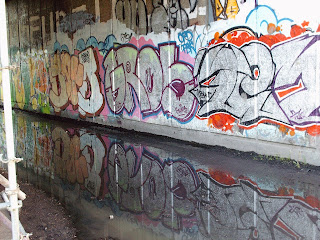
What of the concept of surplus value and the dignity of labour, the connotations of kitsch and artistic folly? To explore this, Field Study's Man in e17 cycled with great haste (to dodge the siren psycho calls of The Marshman Chronicles) across Hackney Marshes and down the Lea, arriving at the construction site for Folly for a Flyover . FSMiE17 freely drilled a number of bricks of which he lost count.




Elsewhere the field student has trekked through, across and around a vast text, a complicated patchwork of local heritage 'debatery' via the Archipelago of Truth and Hansard; here and there.
Needing some rigorous scholarly research to inform and guide his quest for living art, Field Study's Man in E17 (and E11 temporarily) attended Roger Huddles account of the contrastingly plodding settled life yet radical praxis of Ambrose Barker - nowhere but here
What of the concept of surplus value and the dignity of labour, the connotations of kitsch and artistic folly? To explore this, Field Study's Man in e17 cycled with great haste (to dodge the siren psycho calls of The Marshman Chronicles) across Hackney Marshes and down the Lea, arriving at the construction site for Folly for a Flyover . FSMiE17 freely drilled a number of bricks of which he lost count.


Saturday 11th June 2011.
Kissed by intense light at the handles of the pillar drills of wisdom (or folly?), Field Study's Man returned home to help guide Waltham Forest Arts Club members through the coming days of art, alive in the meadows of Shangri La, which is E17.
Subscribe to:
Posts (Atom)